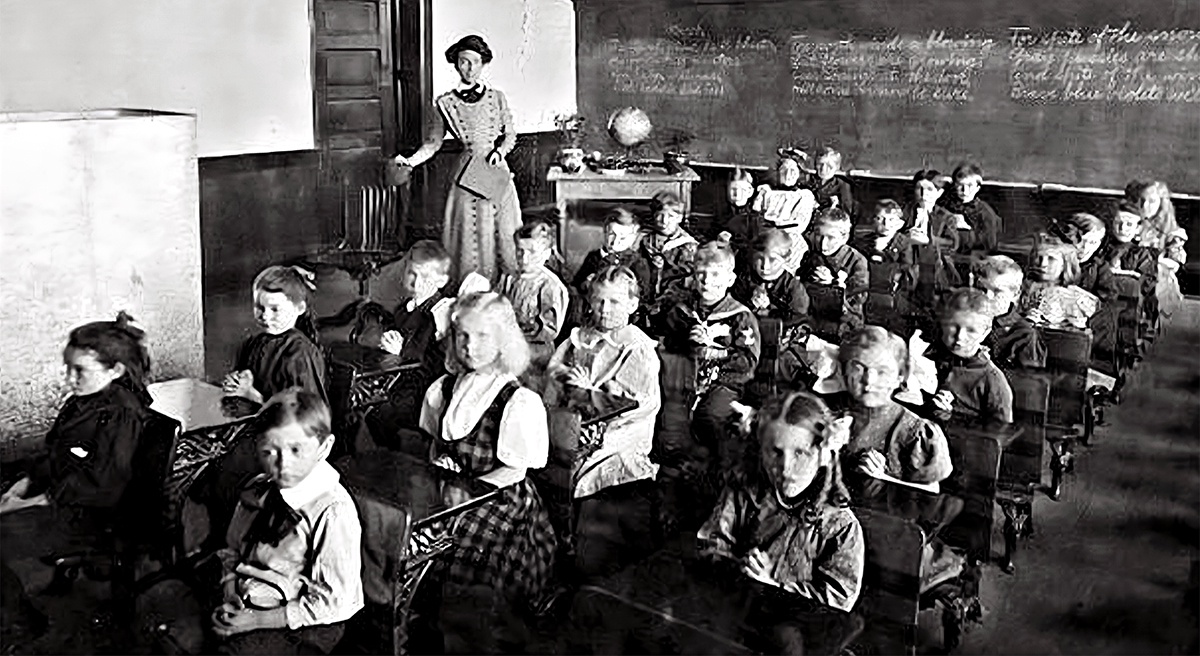
The short answer: Absolutely, yes!
When the following query was posed to Google AI, the results were unequivocal – today’s most widely adopted school design was created to satisfy the needs of industry – definitely not the needs of individual students as unique whole persons.
The Google Query:
“How did modern education come to be set up in the manner of an industrial assembly line, with standardized testing used for quality control and product differentiation?”
Google AI Response:
Modern education was structured like a factory assembly line during the late 19th and early 20th centuries to meet the economic demands of the Industrial Revolution.
This shift was driven by a deliberate effort by industrial philanthropists, efficiency experts, and social reformers to transform a fragmented, agrarian schooling system into a highly standardized machine that could efficiently process millions of future factory workers and managers.
Here is how the system was systematically designed around the concepts of mass production, quality control, and product differentiation.
The Factory Model: Copying the Assembly Line
During the rapid rise of industrialization, schools faced an unprecedented influx of students due to urbanization and child labor laws. Reformers looked to the most successful, efficient model of the era: the factory.
- The Committee of Ten (1892): Led by Harvard President Charles Eliot, this group standardized the high school curriculum, establishing fixed subject blocks (Math, Science, History, English) taught for identical lengths of time.
- The Carnegie Unit (1906): This system tied academic credit directly to “seat time” (the number of hours spent sitting in a classroom), treating education as a quantifiable unit of time on a production line.
- Age Cohorts and Bells: Students were sorted by “manufacturing date” (age) rather than ability. School bells mimicked factory whistles, training students to shift tasks simultaneously and acclimatizing them to rigid, clock-bound shifts.
Standardized Testing: “Quality Control” at the Factory Gates
As schools scaled up, administrators needed a cheap, objective way to measure the “output” of their educational factories. They borrowed the concept of quality control from manufacturing.
- Edward Thorndike and “Scientific Management”: Thorndike, a pioneer of educational psychology, believed that anything that exists can be measured. Inspired by Frederick Winslow Taylor’s “Taylorism” (the optimization of factory worker movements), Thorndike championed standardized testing to measure school efficiency and teacher productivity.
- The Alpha and Beta Army Tests (WWI): The mass testing of 1.7 million military recruits during World War I proved that standardized, multiple-choice tests could be administered quickly and cheaply to massive populations.
- Eliminating Human Variance: Just as a factory inspector checks a batch of parts against a blueprint, standardized tests were introduced to ensure that every student leaving a specific grade possessed a uniform, baseline level of knowledge.
Tracking and Sorting: “Product Differentiation”
Industries do not just produce one item; they create different tiers of products for different markets. Educational architects used standardized testing and tracking to sort human capital into distinct economic roles.
- Administrative Progressives: Figures like Ellwood P. Cubberley (Dean of the Stanford University School of Education) openly argued that schools should act as sorting mechanisms. Cubberley wrote in 1916: “Our schools are, in a sense, factories in which the raw products (children) are to be shaped and fashioned into products to meet the various demands of life.”
- The SAT and IQ Testing: Thinkers like Carl Brigham (creator of the SAT) used early standardized tests to separate the “raw material” into different tracks.
The Multi-Tiered Output
- The “Premium” Product: Students who scored highly were funneled into academic tracks, preparing them for college and management positions.
- The “Standard” Product: Students with average scores were directed toward vocational, clerical, or assembly-line training to fill the demands of industrial labor.
Funding and Philanthropy: Financing the Machine
This transformation was heavily subsidized by powerful industrial titans like Andrew Carnegie and John D. Rockefeller.
Through organizations like the General Education Board (GEB), founded by Rockefeller in 1902, millions of dollars were funneled into modernizing schools. While altruistic, the GEB’s explicitly stated mission in their early occasional papers was to train citizens for contented, productive labor in the existing economic system, rather than to foster critical philosophers or artists who might disrupt the industrial hierarchy.