A Professional Musician Shares His Thoughts
When David Eby isn’t teaching music to children at the Living Wisdom School in Portland, Oregon, he’s a professional cellist with The Bodhi Trio, the Oregon Symphony, and the Portland Cello Project.
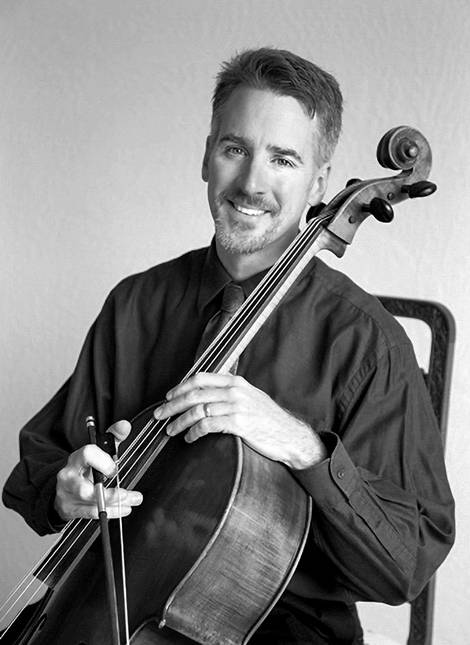 David teaches cello at Lewis and Clark College. He leads the Advanced Strings at Oregon Episcopal School and is a Teaching Artist for the BRAVO Youth Orchestra, an El Sistema program that brings classical music training to disadvantaged youth. David lives in south Portland with his wife Madhavi, their daughter Caitlin, and their Manx cat, Maggie.
(Visit www.davidebymusic.com, where David shares his insights on meditation for musicians and the spiritual healing power of music for our lives.)
David has taught in the Living Wisdom Schools for more than sixteen years, initially for two years in Portland, twelve years at the original school at Ananda Village near Nevada City, California, and now again in Portland.
Q: David, let’s have an informal conversation about the role the arts can play in helping kids be happy and successful in school and their lives. Have you given thought to the role of the arts in children’s development, especially during the “Feeling Years” from 6 to 12?
David: My daughter Caitlin is in sixth grade now, and she’s performing with the Pacific Youth Choir in Portland. They sang Mahler’s Third Symphony recently with the Oregon Symphony, and it was a spectacular, high-powered event — Mahler can be pretty heavy, but she was moved to tears by the beauty of it.
She gets a great deal of joy from music, theater, and writing, and she’s very passionate. She grew up in the Living Wisdom Schools, and she now attends the Arts and Communication Magnet Academy here in Portland. I’ve taken her to choir practice since she was a tot, and as a result she knows our entire repertoire inside and out. (laughs)
In my life, the arts have been a foundational theme. I picked up the cello when I was six, and I knew right away with a solid intuition, “This is my instrument!” Music was a constant throughout my childhood, and playing cello and singing gave me incredible experiences.
It was during those years from six to twelve that my heart was most open and I was able to experience something greater than myself through music, whether we might choose to call it a higher inspiration, God, or my own highest potential. I believe the name doesn’t matter, so long as we recognize the amazing things that music can do for us.
There are two aspects to music. There is, of course, the purely physical, sonic experience, and then there’s the interior, subjective response. The sonic experience is what the sound waves are doing to our bodies. Many studies have shown that music, especially playing an instrument, builds important connections between the two hemispheres of a child’s brain, and that when a child is having a musical experience many areas of the brain become engaged. Music touches a number of brain areas simultaneously, and when we’re performing the whole brain lights up in a striking way that scientists can observe on scans. The effect is there when we listen to music, but to a lesser degree, and even when we’re just thinking of music that inspires us.
So there are the purely physical effects, but there are also other, “energetic” impacts. By “energetic,” I mean the effects of the sound that are touching us in deep ways. It’s what causes us to say, “Wow, oh my, that piece really moved me!” Or, “That music struck a chord with me — I really resonated with it.”
It’s something we can safely say lies beyond our ability to perceive intellectually, and beyond the simple effects of the sound waves on our physical bodies and brains. There’s something that music can awaken in us that’s deeper than the physical beats and sound waves and chords.
Unfortunately, there’s a great deal of popular music today that is nothing more than computer-generated sounds and beats and rhythms and effects designed to impact our brains as “ear candy.” And while it does get our energy moving, and it excites our emotions, when it’s over it just dumps us back out on the curb again.
I’m deeply intrigued by a kind of music that does the exact opposite, a music that bypasses the mind and draws us inward into a oneness with something that’s greater than the little ego, and that we recognize subjectively, in a very real way, as a higher part of ourselves.
Q: Are there levels upon levels of uplifting music? For example, music that can raise our mood, and music that can take us to higher places?
David: I’m convinced of it. I coached at a music camp last week where an amateur quartet played a Schubert piece, and it was lovely. Schubert wrote some incredibly inspiring pieces, and some of his songs have a powerful ability to cheer us up and make us smile and feel that life is good. But I believe there are even higher levels. Brahms said that when he composed music he would come in contact with a divine presence that was “superconscious” — he actually used that word — and that it was from that level that he received his inspiration.
I find that music is a road map for my life, and a source code that can capture inspiration and the state of consciousness that great composers are able to enter and bring into their music. We’re given these dots on the page, and when we perform them there’s a big light that goes on somewhere on the scale of inspiration, and if you play the notes, and you carefully tune into the present moment, and if you’re very focused and receptive, you can get a taste of that big light, or even become wholly immersed in what the composer experienced. And if the composer received it from a very high place — for example Handel’s Messiah — you can feel it touch your soul.
It’s a very effective prescription for bringing your consciousness onto a happier place. It starts with the realm of pure ideas, and it uses energy to create a sonic vibration that transmits those ideas to a place that’s deep within us.
For me, it’s one of the things in our lives, like nature, that can awaken a remembrance in us of a beauty that lies buried deep in us all, and an understanding of where our truest fulfillment comes from.
Our greatest fulfillments never come from anything material, ultimately. When you hear music, can you put your finger on it? Can you capture it? It’s played and then it goes away. It’s this thing that’s completely immaterial, yet it’s one of the greatest gifts that God has given us, because it leads us to the inner kingdom where our universal birthright of happiness already lies, perfect, and eager to fill us.
Q: While you were growing up, and in your career as a musician, was there a point where you felt that there was a ceiling on the inspiration you could tap into through the kind of music you were playing?
David: First of all, let me just say that when I was in the Feeling Years from six to twelve I was a complete music snob! (laughs) My teacher actually had to pull me aside and say, “David, I’m afraid I have to give you an unsatisfactory grade, because your attitude has been really, really bad in music class.” I wasn’t quite sassy enough to snap out a snarky comeback — “Yeah, well, this music is horrible!” (laughs)
But it was. It was totally, totally uninspiring! Yet at the same time, I remember being deeply moved by the folk songs of that time, in the 1970s, especially the tunes from Godspell, and others. My Dad is a Presbyterian pastor, and I grew up in those surroundings, with an awareness of the inspiration of Spirit. So, yes, I had many experiences that reassured me: “As long as I have music, everything will be okay!”
I had some incredibly inspired experiences that carried me through high school, but toward the end of my college years, I had I’d passed through a great deal of formal training, I woke up in a kind of panic one day and wondered, “My gosh, what have I done?”
I thought, “I’ll end up playing in an orchestra, surrounded by miserable, cynical, jaded musicians, of whom there a great many, and uninspired conductors, and an audience that’s dwindling, and music that, for the most part, isn’t inspiring at all.
There’s a lot of music that is inspired, but orchestras often have to program “new music” to win the grants that support the more inspiring stuff, and it’s very unfortunate that in our contemporary music we have a great deal to learn about inspiration. Right now it seems that the more outrageous and atonal it is, the better the music is purported to be, and it certainly can be powerful — but, uplifting? Hmm, I don’t think so.
So when I was in my late twenties I put my career on hold, and I went off in search of the lost inspiration, and interestingly enough, I ended up finding it.
At first, I was looking for a way to serve society through music, because I felt that it would be heart-opening and fulfilling, so I joined a troupe of storytelling musicians who were addressing the needs of children in the Feeling Years from age six to twelve. We would take popular stories and set them to music, and we would act out the characters, like the Pied Piper of Hamlin.
I remember playing the Mayor of Hamlin for a season — I would strap my cello to my body and we would play and sing and enact the story, and for a long time I felt very inspired, because it was serving the needs of young kids who desperately needed upliftment through the arts.
But after a time I began to feel that it was too much about “art for art’s sake,” without a true higher purpose. So I began working with the Suzuki Method, which is founded on a beautiful concept of nurturing children who may never become professional musicians, but who will be human beings with beautiful hearts.
But then I realized that I wanted something more. I wanted to be surrounded by people who weren’t only practicing good teachings, but who were looking for Truth, writ large, because I knew there was a level of music that could truly touch the soul, and it was the kind of music I was longing to explore.
It was then, thank goodness, that I began working as a music teacher at the Living Wisdom School in Portland.
At that point, I had quit professional music, and I dove headfirst into teaching these kids who were in the age group of six to twelve, and it was the hardest job I’ve ever had, because it took tremendous energy to manage the kids and connect with them.
I had a class of all girls and one very shy boy who was overwhelmed and wasn’t able to put out much energy. So for the first two years I had the typical, terribly difficult, soul-searing experience of being a beginning teacher. And then we moved to Ananda Village where I taught music in the original Living Wisdom School for twelve years, and it was a very, very successful and incredibly fulfilling experience.
Q: Here in Palo Alto, the directors of the Living Wisdom School, Helen Purcell and Gary McSweeney, are challenged to explain to parents why we spend so much time on the arts, because the parents wonder if we might be neglecting the kids’ academic studies.
It can be difficult to persuade them that fifty years of experience have shown us, beyond any possibility of doubt, that engaging kids in the performing arts has a very positive effect on their academic performance, because there’s a strong component of feeling in the learning experience, and it needs to be cultivated as an important cornerstone of the academic curriculum.
One of our students is a gifted young classical pianist. Arthur just finished third grade, and you can see that he’s totally focused and engaged when he’s performing, and it’s a quality that carries over to his studies and his interactions with the other children.
In your years of teaching, have you noticed that children’s lives are enhanced by the time they spend with the arts?
David: Without the slightest question. One of my first students at the Portland school was Keshava Betts, who’s now in his late twenties and lives in Palo Alto, where he plays cello very inspiringly and teaches at LWHS.
Keshava realized as a very young child that when he was feeling low, all he had to do was pick up the cello and play and he would very quickly feel better – and that’s a huge gift, to have such a powerful tool to raise our consciousness. It’s one of the most valuable skills we can learn!
I remember coming out of a terrible opera rehearsal one night, and as I drove home through the rain I was feeling utterly drenched by the misery of it all. And then I began to sing a solo that I had volunteered for, from an oratorio called “Christ Lives.” It was just a way to pass the time on a miserable drive and I wasn’t expecting any great change in my consciousness. But then — whammo! — I felt such a tremendous current of joy that I actually had to pull over to the side of the road to avoid being dangerously distracted. I thought, “What in the world just happened?! I don’t understand this. How did this happen?” (laughs)
The song was a very simple piece — it stayed within the octave and it wasn’t sophisticated at all, yet it left me wondering, “How did this move me so powerfully? How was it able to change me in an instant?”
It helped me understand that music can hold vibrations of consciousness, and that when we walk into an inspired piece of music it’s like walking into a beautiful temple. We walk into a holy place and we feel uplifted, and when we walk into a holy song the same thing happens.
This is why I feel it’s such an awe-inspiring responsibility to provide uplifting music for children. I’m teaching music at the school in Portland now, and when the children walk into these pieces, it changes them. So I feel it’s very important to provide opportunities for them to explore those higher places in themselves.
It’s not something you can drive into them — “Now I want you to feel!” (laughs) You can’t force it, and it’s the same with adults. There are adults who love listening to the music, but maybe they have a hard time tuning into the inner experience of it, and it’s a joy to help them find that happiness within.
I’m working with a music education program called El Sistema that was started in Venezuela in 1975 by an educator, musician, and activist, José Antonio Abreu. It brought intense classical music training to the slums, the barrios, and it transformed the society, to the point where 80 percent of the doctors and lawyers and educators had come up through this system as children. — and that’s such an amazingly powerful statistic!
We’re working with children in an impoverished area of north Portland, and it’s hard to measure the changes in the last three years, because how can you compare where a child is now, compared to some other potential for them? But we’ve seen an incredibly positive development of personal skills, confidence, and social maturity.
Q: These inner changes are starting to be documented by science. It’s been shown, for example, that in the presence of expansive feelings such as love, kindness, and compassion the heart’s rhythms become extremely harmonious., and the scientists have shown that those harmonious vibrations have powerful effects on the body and brain. They’ve found, for example, that in school districts where they’ve taught heart-harmonizing methods to the children, including methods that involve music, the children’s grades improve.
David: A wonderful thing about music therapy is that it brings the children into an uplifted, happy place in themselves, without having to nag them into changing. (laughs)
They don’t need a teacher or parent to be yelling at them, “Change your energy!” And the kid is going, “I don’t know how…!” But if you have them perform uplifting music, it puts them in the right cycle automatically and effortlessly.
It’s been really fun for me over the years to have the children perform only very high kinds of music for a time. I was amazed by how the kids never grew tired of it, and if they wanted to learn some new songs, we were fortunate to have lots of pieces to choose from.
Through music children are able to tap into a higher awareness that will always stay with them, without their having to struggle to quiet the mind. We would sing positive, uplifting songs that they loved — like “Mañana, Friends,” or “A New Tomorrow” or “If You’re Seeking Freedom.” And it was amazing how their mood would change.
Q: Thank you, David. In the Living Wisdom Schools we’re inspired by the streams of energy and joy that flow through the environment, thanks in part to the harmonizing influence of the arts.