Many parents simply don’t believe that what’s offered at LWS can possibly be valid, since everybody else is doing it differently.
And yet, a deeper look at schools with more “traditional” curricula reveals troubling omissions.
The shortcomings were eloquently described by Sir Ken Robinson, an award-winning international educational consultant whose talk, “Do Schools Kill Creativity?” is the most-watched in TED’s history, with more than 40 million views by 320 million people in 160 countries.
Robinson shares his thoughts on the need for change in education today:
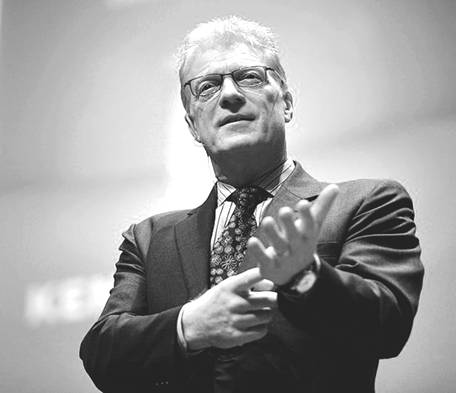
“In place of curiosity, what we have is a culture of compliance. Our children and teachers are encouraged to follow routine algorithms rather than to excite the power of imagination and curiosity…. Human life is inherently creative. It’s why we all have different résumés. We create our lives, and we can recreate them as we go through them. It’s the common currency of being a human being. It’s why human culture is so interesting and diverse and dynamic…. (Photo: Sir Ken Robinson speaks at a Creative Company conference.)
“We all create our own lives through this restless process of imagining alternatives and possibilities, and one of the roles of education is to awaken and develop these powers of creativity. Instead, what we have is a culture of standardization.
“Now, it doesn’t have to be that way…. Finland regularly comes out on top in math, science and reading. Now, we only know that’s what they do well at, because that’s all that’s being tested. That’s one of the problems of the test. They don’t look for other things that matter just as much. The thing about [the] work in Finland is this: they don’t obsess about those disciplines. They have a very broad approach to education, which includes humanities, physical education, the arts.
“Second, there is no standardized testing in Finland. I mean, there’s a bit, but it’s not what gets people up in the morning, what keeps them at their desks.
“The third thing — and I was at a meeting recently with some people from Finland, actual Finnish people, and somebody from the American system was saying to the people in Finland, ‘What do you do about the drop-out rate in Finland?’
“And they all looked a bit bemused, and said, ‘Well, we don’t have one. Why would you drop out? If people are in trouble, we get to them quite quickly and we help and support them.’
“Now people always say, ‘Well, you know, you can’t compare Finland to America.’ No. I think there’s a population of around five million in Finland. But you can compare it to a state in America. Many states in America have fewer people in them than that….
“But what all the high-performing systems in the world do is currently what is not evident, sadly, across the systems in America — I mean, as a whole. One is this: they individualize teaching and learning. They recognize that it’s students who are learning, and the system has to engage them, their curiosity, their individuality, and their creativity. That’s how you get them to learn.
“The second is that they attribute a very high status to the teaching profession. They recognize that you can’t improve education if you don’t pick great people to teach and keep giving them constant support and professional development. Investing in professional development is not a cost. It’s an investment, and every other country that’s succeeding well knows that…. They know that to be the case.
“And the third is, they devolve responsibility to the school level for getting the job done. You see, there’s a big difference here between going into a mode of command and control in education — that’s what happens in some systems. Central or state governments decide they know best and they’re going to tell you what to do. The trouble is that education doesn’t go on in the committee rooms of our legislative buildings. It happens in classrooms and schools, and the people who do it are the teachers and the students, and if you remove their discretion, it stops working….
“Many of the current policies are based on mechanistic conceptions of education. It’s like education is an industrial process that can be improved just by having better data, and somewhere in the back of the minds of some policy makers is this idea that if we fine-tune it well enough, if we just get it right, it will all hum along perfectly into the future. It won’t, and it never did.
“The point is that education is not a mechanical system. It’s a human system….
“So I think we have to embrace a different metaphor. We have to recognize that it’s a human system, and there are conditions under which people thrive, and conditions under which they don’t. We are, after all, organic creatures, and the culture of the school is absolutely essential.”
(From Sir Ken Robinson’s TED Talk, “How to Escape Education’s Death Valley” (2013); used with permission. To watch the full talk, visit www.ted.com.