By Kshama Kellogg, Education for Life specialist and Director of Living Wisdom High School in Palo Alto, California. Kshama has taught in the Living Wisdom Schools since 2008.
I would like to talk about micro high schooling and its benefits both now and for the future, as people begin to find the courage and insights to make changes that are desperately needed in our educational system.

I’ll talk specifically about the Living Wisdom High School here in Palo Alto, California. We are both an in-person, brick-and-mortar school and an online program. We offer our students full academic coursework through 12th grade, as well as a vast array of experiential life skills and values-based training.
I believe it’s important to point out that we are part of a larger network of schools founded more than 50 years ago. The Living Wisdom and Education for Life Schools have established a remarkable record of educating happy, successful young people.
Currently there are four active Living Wisdom Schools in the U.S., and Education for Life schools in Italy, India, and Slovenia. Our high school is a seamless extension of the TK-8 Living Wisdom School in Palo Alto, which was founded a little over 30 years ago.
In 2015 we decided to expand to include the high school years, because we were aware of the dysfunctional nature of much of education for teenagers today. There were a number of teen suicides some years ago in the greater Palo Alto area, and for us, those tragic events highlighted the trauma and discontent and lack of effective solutions in the mainstream educational system.
We were deeply motivated to create a space for learning where the students would be truly cared for; where they could have a real connection with the positive meaning behind their education, and where they would come to an understanding of the bright promise of their lives, and to experience the personal understandings and actions that would bring them true fulfillment and lasting happiness, both now and after their school years.
So we began putting together the steps to create an alternative secondary education, not only so that the students in our own TK‑8 school would have access to a familiar, joy-filled school experience, but to open these thoroughly proven, joyful methods to others who would benefit from them.
I want to talk about the seven key strengths of micro high schools, and the first thing I want to highlight is the wide-ranging studies that have looked at what high school students’ engagement with learning is like today. Shockingly, but perhaps not surprisingly, approximately 75 percent of the students said that the majority of their experience of learning in high school produced feelings not of excitement and hope, but of boredom, discontent, and overwhelming stress. So this was one important aspect of the situation that we wanted to help transform, and I am happy to report that our results so far have thoroughly justified our initial expectations.
The students who come here very quickly awaken to a joy in the learning process that has a profound effect on their success not only in high school but for their college experience, their careers, and their lives.
1. The University Model
At Living Wisdom High School, we have what we call a university model of coursework, which means that each student works with a faculty mentor to design a personalized learning plan that will take appropriate account of their individual abilities, interests, and strengths, as well as their areas of challenge, and their long-term goals.
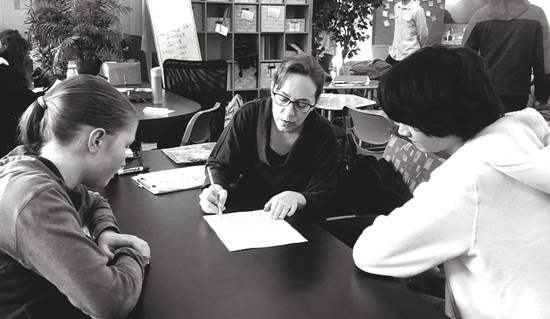
Together, we create a curriculum of coursework that is academically rigorous, that will challenge them appropriately at their own level, and that will give them a deep connection with their academic subjects that will prepare them to thrive in the college of their choice.
Our students complete all of the required courses for high school graduation and college acceptance. We have a wonderful team of teachers who work one-on-one and in small groups with the students to help them discover the joy of diving into their studies, with a view not simply toward passing a test, but to gaining a deep understanding of essential principles, with a sense of engagement and adventure.
In addition, we offer a broad array of wonderful elective courses, advanced pathways, and experiential learning that I’ll talk about momentarily.
We like to think of ourselves as a blended learning community, which means that the learning happens through one-on-one encounters with teachers, mentors, and other students, as well as in a small groups with the teachers. We’ve seen that the blended format generates amazingly vibrant, dynamic, lively discussions that greatly help them to internalize their learning.
Much of our work is project-based, where the students are not passively receiving information but are engaged in the processes of research, sharing, building, teaching, and creating, so that most of their learning happens through their own dynamic experience, rather than only from reading and memorization.
We partner with several online organizations so that our students can take asynchronous coursework which they can complete at their own pace and in their own time. They can work at an accelerated rate, or they can take the time to circle back and deepen what they’ve learned until they’ve reached a point of mastery, before they move forward.
We partner with our local community colleges so that students who have the maturity, intellectual capacity, drive, and personal interest to dive into subject areas they wouldn’t otherwise have access to. The community college coursework can be taken online or in person.
We also offer honors courses for students who qualify and are interested.
As a micro high school, we are able to offer many pathways for the students to pursue their unique interests and be challenged at the level of their abilities. The university model is extremely rich, as it allows them to draw on a very broad range of resources in a highly personalized way.
We also spend a great deal of time working with the students to help them build personal skills in the areas of responsibility, time management, and study habits so that they will be ready to launch into their next learning path after high school.
2. Excellence
We are dedicated to helping each student achieve personal excellence. Instead of raising a fixed bar that every student must hurdle, where the bar would be either too high or too low for most of the students, we work with the individual to determine what their next step can be, based on their readiness.
The approach we take to coursework and the learning process is mastery-based. Instead of setting a fixed finishing line that everyone must cross together in the same amount of time, we support them individually in mastering fundamental concepts before they move on.
Our curriculum includes a great deal of self-reflection, with regular dialogue and feedback from the teachers. Again, these are things you can do in a micro school that are not possible in a mass-production educational system where the teachers are working with up to 150 students every day and are unable to devote time and personal attention to help each student achieve their academic potential, much less help them rise to excellence in the qualities of character that will help them in their lives.
3. Learning Through Experience
We believe very strongly that learning should not only be mental, but that it should engage all aspects of the student’s being, including their bodies, hearts, will power, and souls. So the third strength of a micro high school is that we are able to give each student an education that involves the whole person and that is deeply experiential. Throughout the 50-year history of the Living Wisdom Schools we have seen that experiential learning is enormously important for all our students, but especially in the high school years.
We approach experiential learning in a variety of ways. All of our students participate in what we call passion projects. There’s a great deal of discussion in the popular culture today about passion, and what it means to pursue your passion. In working with high school students, we’ve discovered a wonderful process for identifying, developing, nurturing, and cultivating each student’s particular passion.
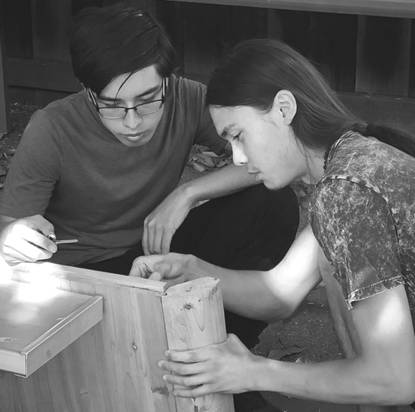 The first point to understand is that our personal passion will not simply drop into our lap. Rather, it requires a process of striving for excellence, developing cooperative relationships, and finding our strengths in our areas of interest, with an understanding that our passion will emerge and grow as we develop an immersion in the area of study that will lead to mastery.
Our students can choose a passion project where they’ll be working with a faculty mentor and a professional mentor in the area of their choosing. For example, the student might choose to explore literary publishing, computer science, neuroscience, photography, or music production.
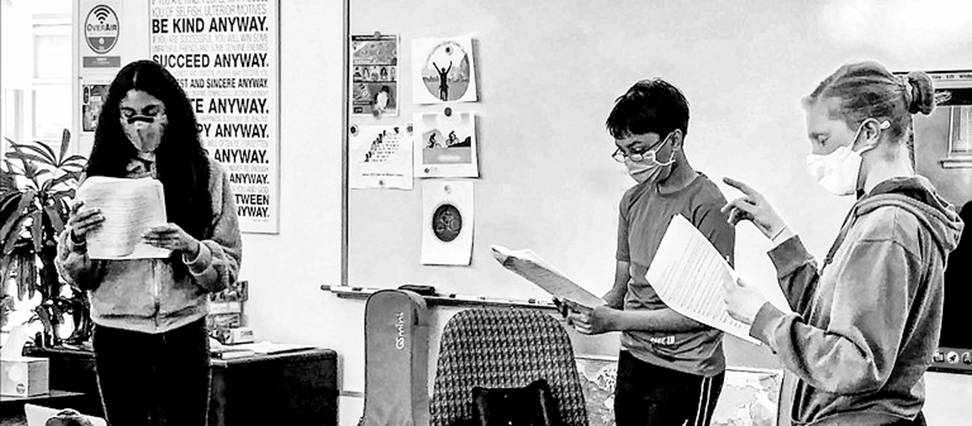
Next, they will step through a process of imagining and planning the project, and designing a course of study that will take them deeply into that area, first by learning about the subject in general terms, and then by engaging with it experientially.
At the conclusion of the process, they will share their passion project with the school. They will reflect on their journey with their fellow students, showing them what they’ve accomplished and talking about the process and how they’ve grown.
The passion project will often lead to a next level of exploration and study. Sometimes, it may even lead to a partnership with the professional mentors with whom the student has been working.
For example, a student who’s exploring a passion project in neuroscience, for example, might be paired with a medical professional, which may lead to hospital visits where they will observe medical procedures and discussions among teams of physicians. In this way, they will get real-life exposure and gain insights into a field that they might wish to enter. Sometimes the pairing process will catapult them into opportunities for longer, deeper internships and other learning experiences.
We also work with experiential learning in the regular curriculum. If you’re studying physics, for example, you might actually build a Newton’s cradle (also called a Newton’s pendulum, a device that demonstrates the conservation of momentum and energy with swinging metal spheres). Instead of merely reading about it, you’ll be building all sorts of life skills and thinking of practical applications for the scientific principles involved.
We do a great deal of learning outside the classroom as part of our life skills training. It may include wilderness training or learning about the culinary arts, sustainability, organic farming, or community development and design. It’s always with a purpose of igniting enthusiasm — not just passively absorbing information from books, but engaging in the processes we’re learning about, and developing personal qualities of leadership and other skills that we can take into our lives after school.
4. Cooperation
We are a community of cooperation instead of competition. Here in Silicon Valley, we find many toxic school environments where the students are in fierce unrelenting competition with each other. At Living Wisdom, we’ve flipped that image to emphasize cooperation and personal excellence, so that our students are driven not by a need for external approval, or to be forever trying to be better than someone else, but by the internal satisfactions of “How can I improve? How can I become stronger? How can I offer my skills to the community to help us all raise ourselves individually to a higher level?”
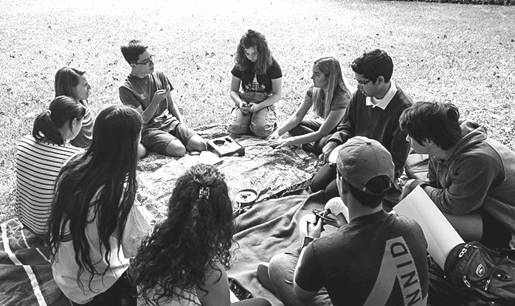 The more we support each other in becoming better, and the more we come together in cooperation, the deeper the internal satisfactions we’ll experience, and the more we will influence the culture to adopt more cooperative ways.
Being able to show up when conflicts and challenges arise, and to know how to work through them, is a tremendous contribution to creating the cooperative environment we treasure at Living Wisdom. Instead of devolving into yet another “us-versus-them” battlefield of cliques and competition, we give our students the tools to create and sustain a community of cooperation, through constant discussion, and by bringing the students into the leadership of the school so that they can feel that they have a say about what’s working for them, and what might work better.
5. Self-Expansion
Self-expansion is at the heart of our efforts to help the individual student rise to their best potential.
We help them experience what it’s like to expand their awareness to include realities beyond their own. All of the areas I’ve discussed so far help them grow larger and more acutely aware. Achieving personal excellence, experiential learning, creating a community, and pursuing their pathway of interest — all of these help our students discover positive options, where they might otherwise be tempted to retreat and themselves close off from the world.
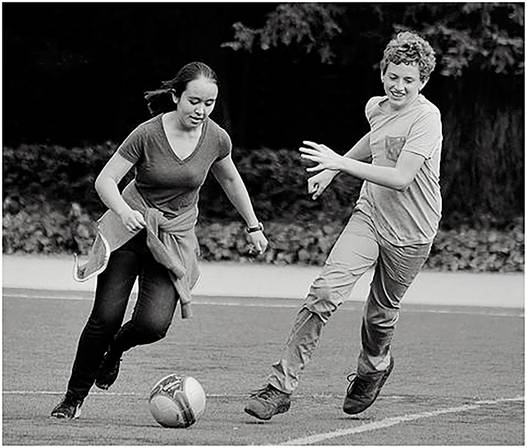 As our students join in local service projects, service travel adventures, and sports and athletics, we see that they come out of themselves in wonderful ways and open up to life, and we see how their high school experience becomes increasingly successful and happy.
The teen years are a time when young people instinctively want to flex their will power and discover how they can make an impact on the world and on the quality of their own lives. And this is one reason why we make service a central feature of every student’s experience.
It may take the form of mentoring a fellow student, teaching young students to read, helping them develop an artistic skill, or coaching them in a sport.
We also do a lot of travel, in a form that we call “service adventures,” where we’re committed to experiencing cultures where people live differently than we do, with an openness to learn from them and share in a mutual exchange.
At the heart of these travel adventures is service — thinking of what can we give, and not just coming into a new place to learn and receive and experience and appreciate, but to explore what we can also offer. Sometimes it’s as simple as giving the quality of graciousness, but there is always an act of service or engagement, and a giving back, wherever we are.
The trips may be domestic. Our sister programs have traveled across the U.S. to work in animal shelters or on sustainable organic farms. Or it might be serving in a national park.

Our service adventure travel is also international. Two years ago, our program attended a conference on climate change and consciousness in Scotland, where we were invited as youth delegates. We listened and learned and shared with a community of scientists, activists, and indigenous wisdom leaders. It was a transformative experience for us all. (Photo: Service adventure travel in India)
Other countries our schools have visited include Mexico, Nepal, South Africa, Costa Rica, India, and Italy.
We empower our students not only to come along on these adventures, but to help plan them and earn the money to pay for the trips. The students fundraise throughout the school year — they take part-time jobs and develop creative sources of income. Our teens have started educational programs for younger students, and they’ve created online and in-person entrepreneurial startups.
There’s a great deal of growth in experiencing what it means to be an employee or an employer, and in learning to work well with people, learning to have a good attitude and a good work ethic, and learning to budget and plan.
A faculty mentor helps the students decide how we will travel and where we’ll stay, how we’ll serve, and the overall focus for the trip. Many valuable lessons in cooperation and leadership are built into the experience.
Aside from the service adventure travel and local service opportunities, we offer athletics. We are part of a Bay Area small school athletic league, and the sports we offer are based on the students’ interest. This year it looks like we’ll participate in basketball, volleyball, dodgeball, and cross country.
These are some of the ways we support our students to expand into their highest potential and find their self-identity.
6. Inner Growth
The seven advantages of a micro high school are important growth points for the students, and an important keystone for their growth is the meditation and centering practices the students experience every day.
There are regularly scheduled focus periods during the school day. We offer them many inner experiences also through their academic studies and the service adventures that reinforce and deepen their relationship with their inner self.
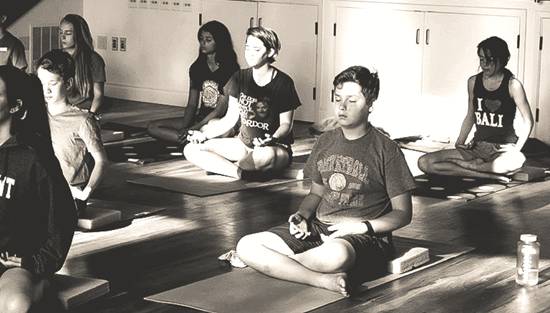
LWHS is inspired by universal spiritual principles, though it is not a religious school. We are a program that recognizes the spiritual core of life, and we respect the many traditions and pathways that people follow in their search for truth. The instruction we offer is nonsectarian — we support young people in their inner exploration of who they are, regardless of their path. We all need regular renewing experiences of calmness, happiness, compassion, clarity, wisdom, and intuitive insight.
We help our students develop these experiences through practices of quiet meditation, and also through yoga and other centering techniques. These practices strengthen the students’ integration of body, heart, will, mind, and soul. They develop deep concentration, and they decrease stress and anxiety. Their positive effects are foundational for every aspect of our program.
7. The LWHS Environment
Our students enjoy learning in a community that is rooted in respect, cooperation, and kindness. They learn in small groups and through regular, individual mentoring that generates a connection between the student and the teachers. The teachers not only provide wise guidance and insights; they also learn from the students — the teacher-student relationships give us valuable insights to help us adjust our guidance to the needs of the individual student.
Mentorship takes many forms in our school. The students meet individually with the core faculty members to discuss their learning and their personal growth-points, and to receive feedback on their work and discuss any personal issues and inner challenges they may be experiencing.
The teen years are very much about discovering who we are. Our core faculty help the students find their own unique self-definition by offering them strong, secure, mature — and very individual — adult role models that inspire the students as they develop their own strong self-identity.
Through the mentoring relationships, we help them improve their study habits and develop communication skills. We are always ready to offer our support in curriculum areas where there may be a need for special help.
People hear the word “micro,” and they think, “Oh — it’s small.” But, in truth, a micro high school is blessed to have the flexibility and freedom to amplify the opportunities and personal attention available to the individual student. Micro high schools are the answer for transforming the challenges of adolescence into wonderful opportunities to discover true happiness through academic excellence, personal maturity, and service.
LWHS and its sister schools have been able to demonstrate that teenagers can experience high school as a thoroughly engaging educational adventure filled with personal victories every day.
In another section of this book, “Meet the LWHS Family,” you’ll learn how our graduates have leveraged their experiences in our schools to achieve success in college and in their corporate and entrepreneurial pursuits.
A keynote of my years as an educator has been the joy of discovering that when we guide teenagers toward realizing their highest, most expanded potential, they develop an openness, an excitement about learning, and a powerful sense of who they are and how they can serve in the world. They discover what’s most truly meaningful to them, and they develop the wisdom and confidence to make choices that will lead to outward success and inner fulfillment.
In the last two years our school has graduated eight students who are now studying at Santa Clara University, San Jose State, Foothill College, Diablo Valley College, UC San Diego, Chapman University, and Cal Poly.
One student felt that she was ready for college after 10th grade, so she entered the early college enrollment program at Bard College at Simon’s Rock. Another student is taking a self-directed gap year with plans to enter a respected program in the arts. Schools that have accepted our students, but where they chose not to enroll, include New York University, Boston College, UC Davis, George Washington University, and others.
I’m sharing this information with you because many families feel that a change is needed in their children’s education, and they are inspired by the opportunities we offer at Living Wisdom High School, but they have questions. “Will this really work for us? Will this school prepare them to be successful? I know they’ll be happy in this school, but what will their opportunities be like after they graduate?”
This is simply to let you know that our students are able to pursue many first-rate learning opportunities after their micro high school experience.
The advantages of a micro school are well covered by the seven points I’ve discussed above. In summary, we feel that we are able to help our students far more effectively at this crucial stage of their lives than a larger institution can.