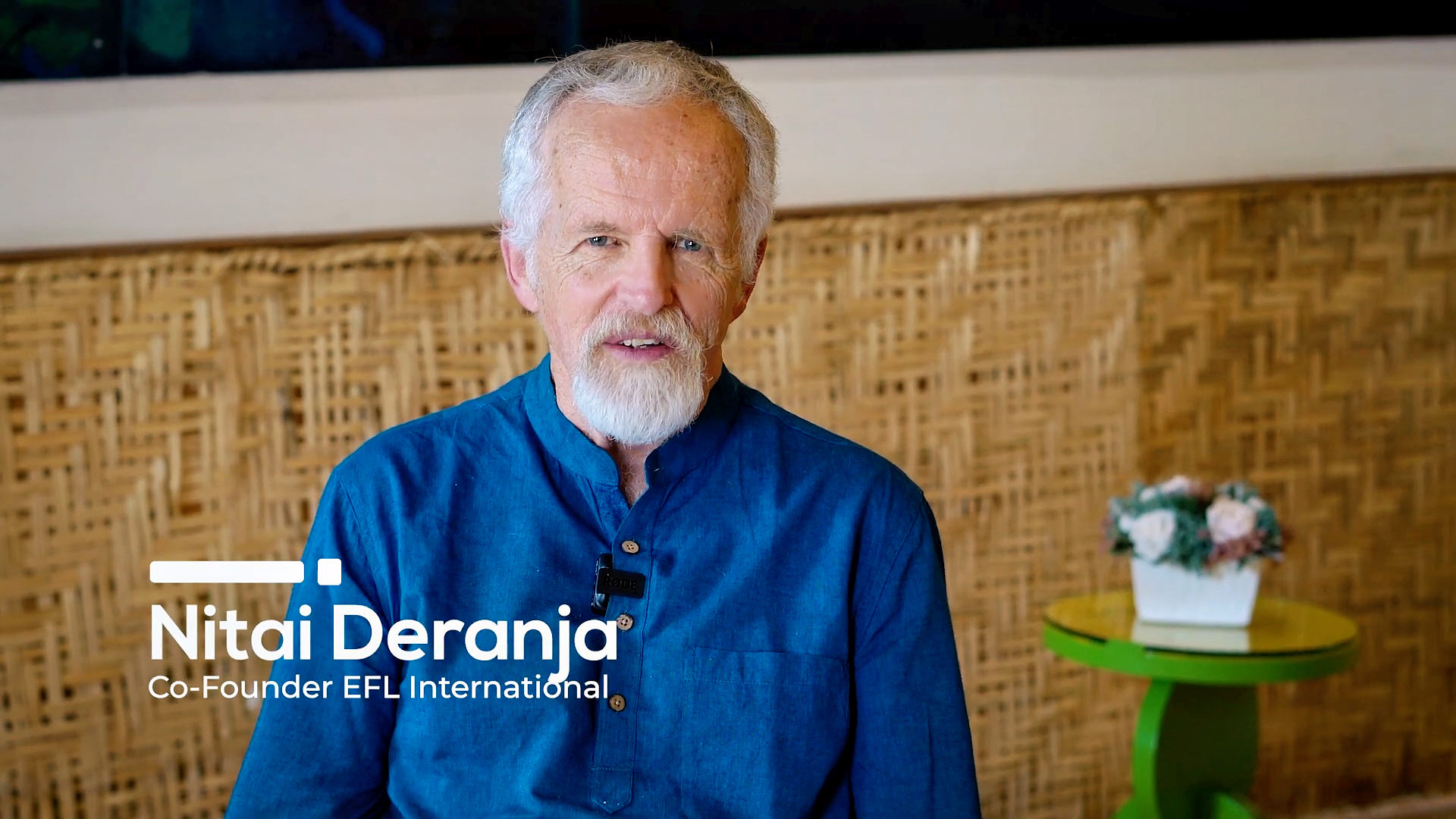
Photo: Nitai talks about the first schools in India to adopt EFL methods. Readers are cordially invited to enjoy a wonderful 4-minute video visit to the schools: Unlocking Children’s Inner Potential With Education for Life.
Q: How did you discover Education for Life, and how did you arrive at a point where you felt the next step should be to introduce it in India?
Nitai: The story actually begins with Autobiography of a Yogi, where Paramhansa Yogananda spends two chapters describing his efforts to introduce a better approach to education.
In 1916, when he was 23, Yogananda started a school in the little West Bengal village of Dihika. There were just six students, and the schoolroom was so primitive that their first need was to put in a floor.
I particularly appreciated that, because when we opened our first school at Ananda Village in 1972, it was in a former chicken coop, and it had no floor. So simplicity was something we had in common.
Once he got the school going, and the news began to spread about this radiant young yogi who was bringing a new approach, he had a lucky meeting that changed the fate of the school.
The Maharaja of Kasimbazar wanted to support Yogananda’s ideas for education, but he decided that before he could fully endorse them, he would first have to put the young yogi’s wisdom to the test.
So he arranged for Vedic scholars to question him about the ancient teachings. But Yogananda turned the tables on them, when he asked them a question that they could’t answer from their books. He asked them where, in the human body, the four qualities of consciousness are localized: mon, buddhi, ahankar, chitta, corresponding to sense perception, intellect, ego, and feeling.
None of the pundits knew the answer, because it wasn’t written down, but Yogananda knew it from his own Self-realization. So he won the Maharaja’s heart, and he gave him his summer home in Ranchi to start a school. It was an amazing gift, because the property was large and beautiful.
In 1972, Swami Kriyananda asked me to start a school at Ananda Village that would be based on Yogananda’s ideal of “How to Live Education,” as he called it.
However, a major problem was that Yogananda had left hardly any guidelines for starting such a school. In his autobiography, he describes the school at Ranchi, but without much detail, although he does give some general ideas. For example, in addition to rigorous academics, there were vocational and athletic activities, gardening, and the care of animals.
From these small glimpses, I was able to understand that he was concerned for the students’all-round development, and not just for educating their minds. I also realized that his school closely matched the Vedic ideal of a gurukul, a school in the classical Indian tradition where spiritual development was the primary focus.
The Ranchi school was grounded in the Vedic traditions as they were practiced in India at the time – for example, the students and teachers would get up at four in the morning and chant slokas. So it had that flavor, but it also had an informality that we can deduce from the glimpses he gives us of how he interacted with the boys.
An example that I particularly love is the story of two boys who were always fighting, and how he made them sleep together in the same bed.
One night, he crept into the room and shook each of them while they were sleeping. They woke up shouting and ready to fight, but when they saw him, they burst out laughing – “You!” And it was the start of a close friendship. So, a great deal of his teaching wasn’t about academics, but instruction in how to be successful and happy in life.
In his autobiography, he gives a very warm impression of the school, and the love that pervaded it. But the story of the two boys suggests that it wasn’t a sentimental kind of love; rather, it was a love such as an avatar such as Yogananda could give them, that was addressed to helping them rise into higher levels of happiness, with complete inner freedom as the goal. Thus, in his love for his students, he would challenge them to grow, and he would teach them to challenge themselves to grow.
Yogananda was in charge of the school from 1916 to 1920, at which point he came to America.
When Swami Kriyananda became his disciple in 1948, Yogananda trained him to carry forward his educational ideals, and when Swamiji asked me to start a school, I was able to get a general idea of the Master’s ideas from his autobiography and from a few small things he had written about the spiritual development of the child.
But there were obstacles, because we weren’t living in a culture with deep Vedic roots, so there wasn’t a ready-made cultural foundation that would enable parents to understand our kind of school.
Yogananda came to America in response to what he described as a silent longing of many souls for “a practical religion.” He was concerned that religion in its present form was ill-equipped to meet the twin challenges of modern science with its atheistic bias, and fundamentalism with its demand for blind belief.
He was concerned that people’s faith was being shaken by these challenges, for which their belief systems had only weak answers. Many thinkers in the West were misinterpreting the findings of Einstein and other scientists, claiming that they proved that life is meaningless, that it has no higher purpose or goal, and that the ultimate reality of creation is matter.
At Ananda Village, we were defining a Vedic culture for modern times that looked very different from traditional Hinduism. Swamiji said that what Paramhansa Yogananda introduced to the world was not Hinduism, but a “new dispensation,” as he called it. He said that he had been sent by God to help people who had been born into a dawning age of energy-awareness. What he taught was the ancient Vedic wisdom, translated for modern, scientific minds.
Swami Kriyananda had been inspired to publish a book that refuted the atheists and nihilists. He explained that the same scientific discoveries on which they based their views, when interpreted in the light of the Vedas, suggested that life is deeply meaningful, with a glorious spiritual potential.
That book, Out of the Labyrinth: For Those Who Want to Believe, But Can’t, is aimed at college-trained readers, to give them an alternative to the false interpretations of the nihilists that they had been fed by their professors. Later, he wrote a book that was based on the same ideas, but was aimed at a more general audience, Hope for a Better World! The Small Communities Solution.)
Swamiji brought forward the Vedic truths in their original clarity, stripped of centuries of priestly elaboration and misinterpretation. It was Eternal Truth for modern, scientific minds. It fulfilled the longing for a practical religion by showing people how they could have a direct experience of God in the laboratory of their own bodies, by conducting experiments with the appropriate scientific tools of prayer and meditation. Yogananda promised: “At the inner end of the human nervous system, the mind, interiorized, communes with God.”
At our school in California, we didn’t get up at four to chant slokas, but we did many things that Yogananda introduced, including teaching the children to meditate, and how to be successful and happy.
Q: You had a rather rebellious group at the start, didn’t you?
Nitai: (Laughs) Yes. What we were hoping to do with the school was challenging for the parents and the kids at that time. It was the 1970s, when there were strong currents of rebellion against traditional ways, and even the idea that you should show up at school at a certain time every morning was difficult for some of the parents and children to swallow. But with perseverance, we were able to establish a school along the lines we have today, and it has been very successful.
In 2019, there was a grand celebration of Ananda’s fiftieth anniversary. It was held at Ananda Village in California, and a woman came to the festivities who would play an enormous role in supporting our efforts to bring Education for Life to India.
Her name was Pia Singh. She was the youngest daughter of Kushal Pal Singh, the chairman and CEO of DLF, a major Indian real estate firm that was founded by his father-in-law, Chaudhary Raghvender Singh.
By Indian law, corporations above a certain size must create a foundation to distribute two percent of their profits to help society. When we met Pia, she was in charge of the DLF Foundation, and she was tasked with overseeing three schools in Gurgaon and a school in New Delhi that DLF was sponsoring.
The schools were operating along traditional lines, and Pia was looking for a way to ignite a creative spark and make them more magnetic and dynamic, in line with a growing feeling in India that it was time for a less rigid, more human-centered but still rigorous approach to education.
When Pia asked her secretary to look at the options, she came across something called Education for Life. No one in India knew about EFL, so it was unknown to Pia, even though she was part of Ananda, and it was a bit ironic when the secretary presented it to her and said, “Isn’t this part of your guru’s work?” (Laughs)
Pia liked the concept she chose to proceed. She came to the celebrations in California to learn about EFL, and I was invited to a special luncheon for her and her traveling party. There were seven or eight of us, and as we talked, Pia suggested that we might come to India to see if we could figure out a way to bring EFL into the four schools.
We were inspired, particularly Aryavan McSweeney, who had lived for several years in India doing video production for Swami Kriyananda. Aryavan had a lifelong relationship with Education for Life, having spent his first nine school years in the Living Wisdom School in Palo Alto, California. His father, Gary McSweeney, was a founding member of the school’s board and had taught middle school there for twenty years.
I was, of course, very interested, and before long I flew to India to see how I might help. It was at exactly the moment when Covid struck, so we got off to a shaky start, what with having to do a lot of communicating online, and trying to train teachers in the midst of the pandemic. But we persevered, and when I arrived in January 2022, Aryavan and I set about trying to see what we could do.
It was a completely new adventure for EFL, because we had only operated on the West Coast of America and in Europe.
We had found that parents would join our schools even if they hadn’t been looking for a new approach, because they were attracted by the happy magnetism that permeated the campus. And when they dived deeper into EFL, they liked it even more and would happily enroll their children.
But the Indian schools presented a completely different situation. They had operated on strict traditional lines for thirty years, and none of the teachers, parents, administrators, or children knew the first thing about us.
Meanwhile, Pia realized that she needed to put someone in charge of the project who could support us and help get EFL introduced. The person she chose was Dr. Ameeta Wattal, a woman with forty years of experience in education who had been the director of Springdale, one of India’s best-known schools. Ameeta had left Springdale, and when Pia got in touch, she was receptive.
During their first phone conversation, Pia began talking to Ameeta as if it were a normal business call. But then she paused. She said, “You know, I’m feeling inspired to talk to you in a different way. I want to tell you about my spiritual journey.”
She described some of the experiences that had led her to Ananda, and when she mentioned Yogananda, Ameeta said, “Yes, I’ll do this,” because her father had given her a copy of Yogananda’s book Autobiography of a Yogi when she was twelve, and they had read parts of it together.
There had been other times in her life when Yogananda’s name had come up, and while she hadn’t dived deeply into the teachings, it was something she felt she shouldn’t ignore, so she agreed.
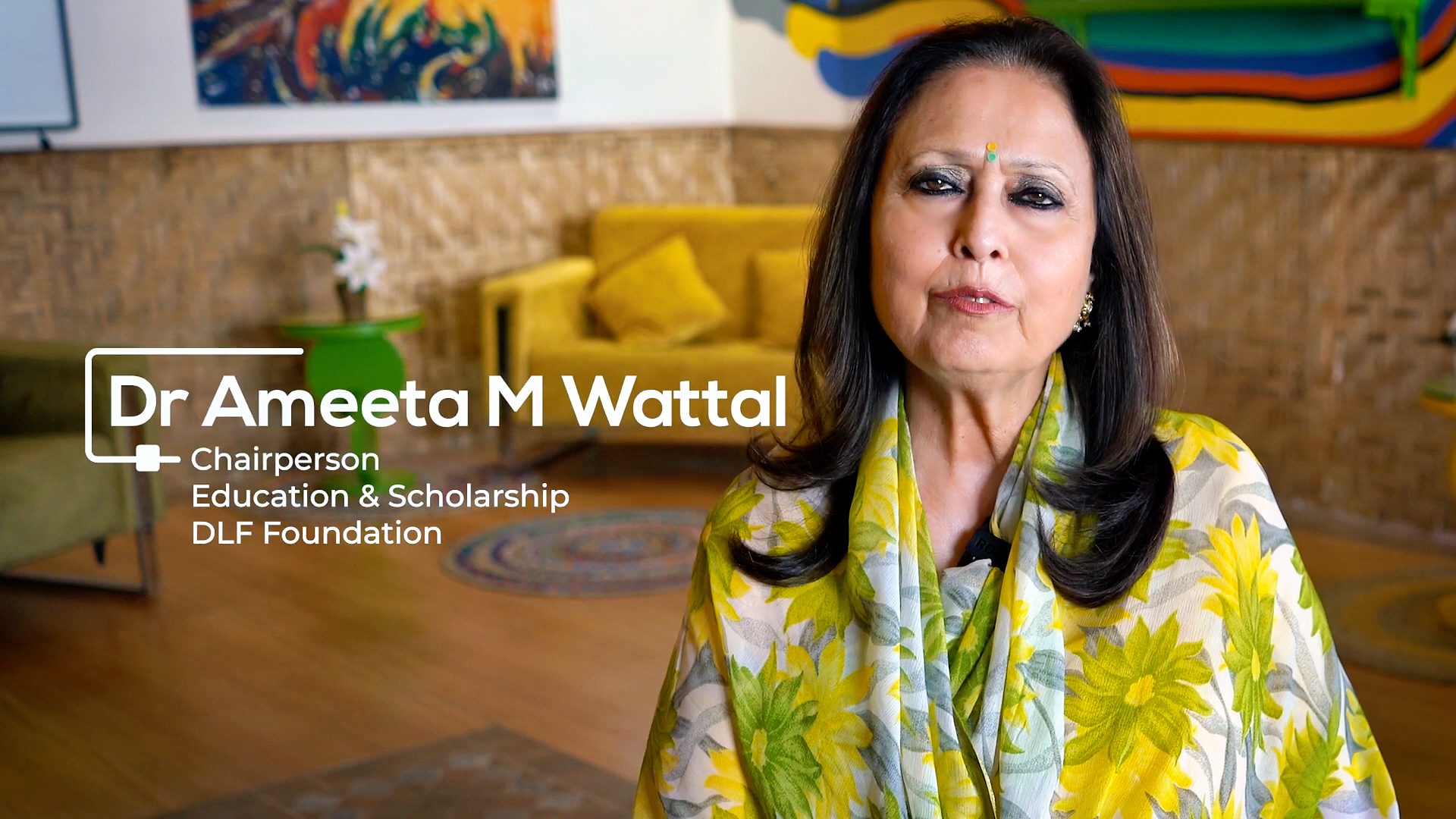
Pia was now able to withdraw and turn over the reins to Ameeta, who became the schools’ overall director. She began hiring principals for the schools that she felt would be receptive to new ideas; but still, none of them, including Pia and Ameeta, were deeply familiar with EFL.
When Aryavan and I went to India, we met with Pia and Ameeta, and they decided to start a pilot program in the oldest of the four schools.
When we began meeting with the teachers and talking about EFL, they were understandably concerned. “Why are we doing this?” “What’s this about?”
I had my own private reservations, because these were definitely not EFL schools, and the environment was very different from what I had known for the last fifty years.
Not long after I arrived, Ameeta said, “Let’s go to Ranchi!” where Yogananda started his school in 2016. “And let’s ask for his blessing on this project.”
Again, I was a bit culture-shocked. Swamiji had told me, “There’s nothing to learn at Ranchi,” because the school had drifted from Yogananda’s ideals, and when I visited Ranchi in 1980 I found it exactly as he said.
Ranchi had been hard to get to in 1980, so I was thinking, “My goodness, we’ll waste an entire week of our training time.” But Ameeta said, “No, no, we’ll fly over tomorrow.” I said, “Ranchi has an airport?” She said, “Of course!” Because a great deal had changed in the last half century.
We hopped on a plane and flew over and got in a taxi and spent the day at the Ranchi school, then we came home the same night.
While we were at Ranchi, I had a strange experience. It was the middle of the day, and I had finished meditating and was walking around the grounds, when I suddenly had a strong mental image of a small package resting on a desk.
I thought, “Oh, this is new,” and as I mentally opened the package, an idea came fully formed that we should hold laboratories in the schools that would condense Education for Life into a package that could be implemented in a very simple way, with just one or two 45-minute periods per week.
So instead of thinking of the difficulties and hurdles, we could focus on small, manageable laboratories where we would help the teachers understand how they could introduce EFL in the situations they already had in place, in an enjoyable way that wouldn’t be burdensome or give them extra work.
Still, as we began to implement the idea, I continued to have private doubts, because I wondered how we could make a significant impact on the prevailing system by spending only 45 minutes with the teachers and kids once or twice a week. Would it even be worth the effort?
But then the amazing Indian culture clicked in, and I began to understand that the Indians had grown up with deep Vedic truths embedded at the deepest foundation of their daily lives.
At its core, Education for Life is entirely about the ancient eternal truths applied to education. So even though the teachers didn’t have access to the ideas in an intellectual way, the basic understanding was there already in their hearts, because every Indian grows up knowing about these things.
They had all heard the term samadhi, for example (divine ecstasy), and they knew about meditation. They knew the wonderful stories of Rama and Sita, and Krishna and Radha, and it was part of who they were. The teachings of India give us a sure and clear understanding of how we can find increasing happiness and success in our lives.
In America, our awareness of spirituality is much more fragmented and hazy, and it isn’t oriented around a single body of truth. But the Indian culture is very cohesive and whole in that way, and it’s tremendously powerful, because it has been the bedrock of the culture for millennia.
In our laboratories and training sessions, we quickly saw that the teachers were responding to a realization that EFL was anchored in an understanding of life that was attuned to the ancient wisdom, and we began to realize how easily they were able to touch into the core of EFL, which, if you look at it closely, is pure Vedanta. The teachers were magnetized by it, because there was something about it that vibrated with their understanding of life.
Still, just imagine the image! Here were these two Western guys talking to the teachers about something they had never heard before, but that was resonating with something deep inside them. And maybe they didn’t know exactly what was so appealing about it, but they felt drawn to want to be part of it.
So it was very, very surprising, and I would say that, of all the teachers we met, perhaps ninety percent quickly responded at a heart level, and not just intellectually. And, of course, that was a huge advantage, because EFL needs to be understood from the heart.
The intellectual side could always come later – it was embedded in the underlying structure of EFL. But it was the immediate recognition of the heart that made our time with the teachers and students so vibrantly alive, and in a relatively short time we began to see it affecting the teachers, the students, the parents, and the whole school.
It was a phenomenon that we had become familiar with in America, and that people would remark about, over and over – how the moment they set foot on the grounds of an EFL school, they would sense a wonderful atmosphere of love and joy that saturated the environment.
It was very powerful, and very unexpected for all of us, including Pia, Ameeta, Aryavan, and everybody connected with the schools.
I don’t think that Pia had any idea how well it would work out, but it did, and we are now at a point where the teachers and children in the original school have worked with these methods for three years.
I was talking with the soumiya recently, the school principal, and I said, “You know, this school feels like an Education for Life school now.”
I said, “Whenever I come here, it has the same vibration as the schools at Ananda Village and Palo Alto. I get the same feeling, even though the school is radically different in many ways.”
First, there are 450 kids in the school, where our largest EFL school in America, the Palo Alto Living Wisdom School, has just 70.
In a way, we’ve completed a cycle. In our first school in America, we were trying to resonate with the school that Yogananda started at Ranchi. And now EFL has come back full circle to its homeland as a mature and proven system.
I have no doubt that Yogananda foresaw that it would unfold this way. Why did it have to come to America first? I suspect because it was easier in America to start something entirely new in education, especially in the 1970s, when the whole culture was open to fresh ideas and change.
In India, the other three schools are a little behind in how far they’ve come with Education for Life, but they are progressing steadily, and they already have the wonderful vibration that is at the heart of the EFL schools.
It’s been fascinating to see how completely different this expression of EFL is, compared to the schools in Palo Alto and at Ananda Village, and yet how very similar the vibration is at the heart of the schools.
We’ll soon have a meeting to determine if we’ve completed the first chapter of EFL in the schools, and to think about what the next chapter might be.
We’ll talk about our options, including online programs where teachers can train and share with each other, and how to keep the vibration of EFL strong in the first four schools. The teachers have been trained, and they now have the background to lead laboratories and help other teachers implement EFL in the way it’s been done with such success there.
We’ve demonstrated that EFL can work in regular Indian schools, and that it is valid for students from wealthy families and families that are poor. The fourth school is a Hindi medium school, but we’ve shown that it can work at every level, and that we are ready to reach out to see if we can help other schools discover EFL.
The vision is that it will spread first in India. Why would this be desirable? Because the Indian schools are in crisis, and they have strayed from their Vedic roots.
There is the same confusion in India between strict academics and human values that we find in schools everywhere today. But having witnessed how eagerly the teachers respond when they are given this opportunity, I believe that EFL can go much farther, because there’s a great global need. We have built the foundation, and I believe EFL will spread through India, and that from there it will spread around the world.