
By Aryavan McSweeney
I serve as director of the Living Wisdom School, an Education for Life school in Palo Alto, California with seventy students. We started our school thirty years ago, and it has thrived, even though our approach differs radically from other schools.
In my role as director, I often meet with parents who are looking for a school for their child. I’ll talk with them about the school, and they’ll ask me questions. As we walk around the school and stop by the classrooms to observe, I’ll talk about how we place a very high value on helping the children enjoy the curriculum. Many parents are enthralled by this idea. They love the thought that their child can learn with joy, because for many of them, it wasn’t their experience of school.
But sometimes I’ll see a faraway look come into their eyes that tells me they aren’t convinced.

It always comes down to the same question: “We think it’s wonderful that the children are enjoying school – but how are your academics? If the children are so happy, and if they’re having such a good time, how can they possibly be learning enough?”
As the school director, it’s part of my role to help parents understand how we are able to do academics extremely well. Our children are admitted to the best high schools and colleges, where they thrive. But, of course, I always want to make sure the parents understand what they’re getting into, because if they choose our school, they’re going to see their children come home happy every day, and they’re going to see them deeply and enjoyably engaged with their lessons. And if they’re accustomed to a different model of school, where learning must be hard, it can be a bit unsettling.
Recently, as I was touring the school and talking about how joy and learning go together, the mother persisted in asking, “Yes – but what is your curriculum?”
I would start again, “Joy…” and she would say, “Yes, yes – but what are you doing with reading and math in kindergarten?”
We went along like that for a while, and when we entered the kindergarten classroom I talked about how important it is to enjoy learning, because the brain learns better when it isn’t in a state of stress. Brain scans show that we absorb information much less efficiently when we’re feeling stressed, tense, judged, and our self-worth is on the line.
Meanwhile, the mother was flipping through a book that she picked up in the classroom, trying to figure out the curriculum.
I thought, “I’ve tried everything, but I won’t give up. I’ll try one more time…”
I knew that the mother was successful – she had a high position in a technology firm, so she had definitely “arrived” in a material sense.
I said, “You know, for many people, academics are their only barometer for success. They work hard to get a good job and earn lots of money and have an impressive life, and when they’ve achieved it, they turn around and wonder, ‘Now what? Wait a minute – is this really it? I was promised that I would feel fulfilled if I made a lot of money and got a great job, and why am I not feeling that way?’”
The mother looked up from the book with surprise and said, quietly and thoughtfully, “I know exactly what you mean. I go through that every day.”
Our educational philosophy comes down to how we answer the simple question of what it means to be truly successful in our lives.
We all define success in ways that are personal to us. But I believe the caste system of ancient India gives us a useful tool for understanding what the highest kind of victory means for everyone.
On one hand, there are eight billion approaches to success, one for every person on the planet. But we all fall into certain broad categories, depending on how deeply we have understood what success actually means.
Paramhansa Yogananda said that the caste system was created in more enlightened times. It was a time when people could move freely between the castes, according to their individual strengths.
The caste system has become misunderstood, and I won’t go into that subject – suffice it to say that we all fit into four broad categories according to our essential consciousness.
At the first level, called the Shudra caste, we’re motivated to avoid pain, and that’s what we consider a victory. But as our understanding of life deepens, we grow into the next level of awareness, the Vaishya or “merchant” caste. At that point, we realize that if we will just apply a bit of cleverness and energy, we can get more of what we want in the form of material things and creature comforts, and we’ll feel victorious when we can get money and the external trappings of wealth.
At the level of the Kshatriya caste – the spiritual warrior – we have realized that we’re happiest when we use our intelligence and strength and energy in ways to include the happiness of others. But we still aren’t yet free of thought of self.
At the Kshatriya level, we love to be able to help others selflessly, but at the same time we’re still thinking, “I would like my king, my queen, and my generals to appreciate me.” Even though our sense of honor and service is deeply internalized, there’s still a craving for a degree of external recognition and support. So there’s still a desire for validation from outside.
At the highest stage, the Brahmin caste, we understand, “I am motivated entirely to find inner freedom, because I know that I can serve others and find my greatest fulfillment by uniting my consciousness with God who alone can help others in the best possible way through me. I am motivated to become inwardly free, and to help all to find their own inner freedom.”
In ancient times, the caste system did not rigidly say that a Brahmin must always be born into a Brahmin family, or that a Brahmin could never be born into a Shudra family. Rather, the general understanding of caste had to do entirely with individual consciousness.
There was an elderly woman who met Yogananda in her eighties. She lamented to him, “I’ve wasted my years – I could have been practicing these teachings my whole life!” The Master told her essentially, “Don’t worry about it.” When she died, he said that in her few remaining years she had practiced with such intensity and such an all-consuming desire for freedom that she achieved liberation in that short time.
We may want to serve others and keep improving, but then perhaps our priorities get distracted for a time while we’re focused for a while on the big promotion. But if we’re sufficiently aware, we will come back to feeling that our soul is calling us to strive to find our freedom by including others.
This is what an Education for Life school is about. It’s about understanding that the goal of life, for each of us at our level of awareness and understanding, is to keep advancing toward ever-increasing happiness and fulfillment, and away from actions and thoughts that can only bring us suffering.
Parents who tour our school often ask us, “Is this a religious school?” I tell them honestly, “No, but it is a meaning-based school.” Because we saturate the curriculum with the idea that life has meaning, and that it holds a promise of fulfillment for each of us, at whatever level we presently are in our consciousness.
During my first thirteen years, I spent nine years in an Education for Life school. When I graduated and entered high school, I was given a book of rules that I was expected to follow. It included a dress code, and a requirement that we get to class on time, and it warned us that if we didn’t follow the rules we would find ourselves staying after school in detention.
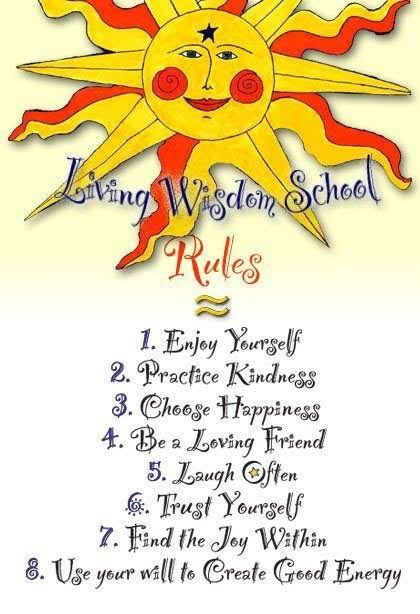
In an Education for Life school, we do have rules, but they are different. They aren’t intended to create an orderly environment, but to help us have a happier, more fulfilling life:
Tandava, our middle school teacher, and I are studying the school rules with the students in sixth through eighth grades, age ten to fourteen.
What do the rules truly mean? Why are they “rules”? They aren’t meant just to keep us moving along in orderly rows. They are meant to help us individually to understand the actions and attitudes and thoughts and feelings that bring us more happiness and freedom. Which, of course, includes the ability to be victorious in our schoolwork.
The school rules express principles that are taught in all paths. They are the Yamas and Niyamas of the Bhagavad Gita, the Ten Commandments and Beatitudes of the Bible, and the Eight Noble Truths of Buddhism.
Every tradition has its version of the rules, because they tell us which attitudes and actions will bring us happiness, success, and victory.
Swami Kriyananda composed a song called “If You’re Seeking Freedom.” The words urge us to reclaim our God-given birthright of freedom and joy. An interesting thing is that it starts by naming the things that won’t help us find true joy and freedom. (You can watch a choir sing it on YouTube.)
If You’re Seeking Freedom
If you’re seeking freedom
In a revolution,
Oh, if you’re seeking freedom,
You won’t find it there.
For once the guns stop blazing,
You’ll find it amazing
How the world can drag on
Just as before!
If you’re seeking freedom
In a marble mansion,
Oh, if you’re seeking freedom,
You won’t find it there.
For even when it’s sunny,
You’ll be counting money,
Keeping up that showcase,
Your face lined with care!
And if you’re seeking freedom
On a throne of power,
Oh, if you’re seeking freedom,
You won’t find it there.
For though men all obey you,
What if they betray you?
Tense you’ll be, and waiting
For foes everywhere!
But if you’re seeking freedom,
Cast away desires.
Why barter like a beggar?
You’ve wealth everywhere!
For never can you buy it.
Grasp, and you deny it.
Freedom can’t be hoarded:
It’s free as the air!
And if you’re seeking freedom,
Seek it on the mountains,
God’s sunlight on your shoulders,
The wind in your hair.
For there’s no one can hold you,
Boss about, or mold you.
Once your heart is free,
You’ll be king everywhere!
In the EFL schools, there’s a continuous underlying hum. It’s a vibration that is created by awareness that we can all be happy at our level. It’s a vibration that permeates the school, and that people they feel the moment they step on the grounds.
At some point in our lives, we will have to understand that our inner reality is more important than anything outward, and that outward success follows naturally once we’ve learned certain essential inner skills – for example, the ability to focus our attention, and to have high energy, enthusiasm, perseverance, courage, kindness, compassion, self-restraint, and respect for other people’s realities.
When Tandava and I talk with the middle schoolers about the school rules, we aren’t just ordering them, “You must practice kindness! You must choose happiness!” We’re urging them to take a scientific approach and make their own experiments, and see if they’ll find that these things work in the laboratory of their lives.
We invite them to experiment with each of the rules for a week or two. What does it feel like to practice kindness? What does it feel like to be a loving friend? What do they receive in return? Because once you’ve experienced kindness and its inner rewards, that’s when it will become a deep and helpful conviction for you.
The Yamas and Niyamas and the Ten Commandments are inspiring when we read them in a book. But they only reveal their liberating power when we engrave them in our hearts. We must gain a conviction born of our own experience. Only when we have tasted the happiness that the rules bring will we be motivated to keep following the path of inner self-expansion.
This is something that we are intent on helping the children understand every day, because it is the foundation for success and happiness in academics and life.
When a child begins to have small successes in math at his level, he finds the experience enjoyable, and he wants to repeat it. Our teachers are trained to help each child become absorbed in a love of learning that grows out of their own actual experience.
The children will only pursue with full energy and enthusiasm something that they deeply want. And this is why we are concerned to make the academics challenging and rigorous, and to give each child enjoyable daily experiences of success, so that they will become enthusiastically immersed in their school work.
I can talk for hours with the parents, but it’s only when they see the children enjoyably focused on their work that their eyes light up, as they begin to understand that happiness and love and joy truly are the most powerful magic formula for success at school.