
The Accelerating Pace of Discovery and Innovation, and the Changing Nature of Work
In 1894, Sri Yukteswar Giri, a highly respected master of yoga in Bengal, published a book called The Holy Science, in which he corrected certain errors that had crept into an ancient system of world chronology known as the Yugas.
The idea of the Yugas is that human consciousness rises and falls, expanding and contracting in cycles of 24,000 years, with four Yugas in each rising and descending 12,000-year arc of the cycle.
The Yugas correspond to the Greek system of iron, bronze, silver, and golden ages, during which human consciousness is able to perceive the reality of creation in increasingly refined ways, as matter, energy, mental power, and divinity.
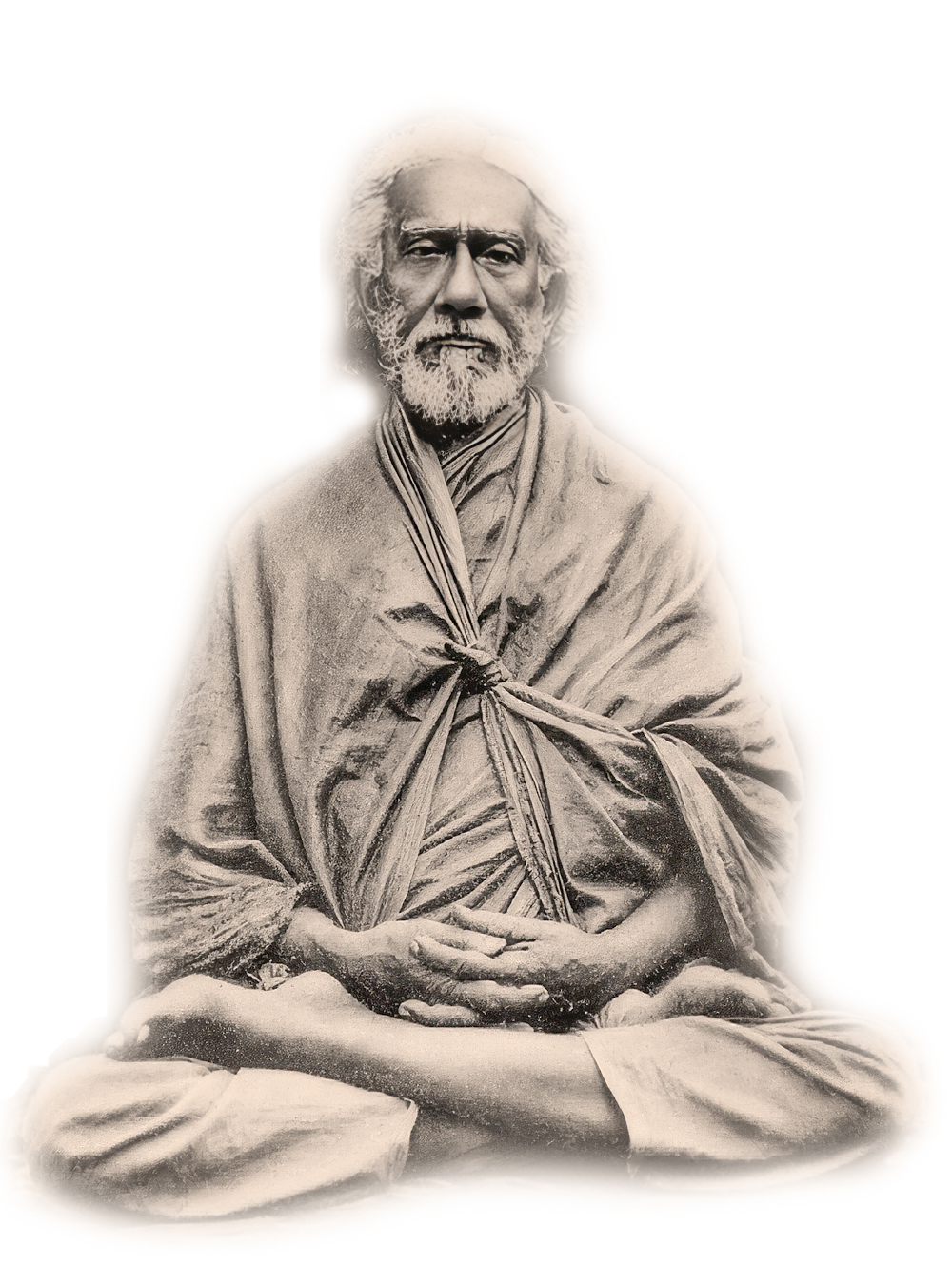
Sri Yukteswar predicted that in the year 1899 the world would enter the full flood of a new age of energy-awareness, which the ancient scriptures called Dwapara Yuga (Sanskrit: “the second age”).
He predicted a rapid advance of new energy-based technologies and scientific discoveries in the 20th century – a prophecy that was, of course, fulfilled spectacularly. All of the significant inventions since 1900 have been based on the new awareness of energy as the underlying reality of the material world.
Sri Yukteswar said that whereas the emphasis in the preceding age of matter-awareness, called Kali Yuga (“the dark age”), was on fixed laws and customs, institutional authority, and mass conformity of thought and behavior, the focus in the age of energy would shift to the individual, and individual growth.
A point to be taken here is that we have not yet seen the new energy-awareness alter the way we educate our children to a significant degree. This is because public education is like a giant ship, and it will take enormous, sustained pressure to turn it around.
However, independent schools that operate outside the aegis of public education have begun to forge fresh paths using energy-aware methods with great success.
Amusingly, there’s already a side of the campus at every public high school where energy-based methods are being adopted at a dizzying pace – and that is the sports complex.
It has happened in sports at all levels. A notable example is the San Francisco Forty-Niners American professional football team.
In 1979, the Forty-Niners hired a new coach, Bill Walsh, to take over a team that had won just two games and lost fourteen in the previous season. Under Walsh, the 49ers won the Super Bowl three years later, a staggering achievement that was possible because Walsh knew how to work with energy.
As part of his agreement with the 49ers, Walsh insisted that he be given authority to turn the organization upside down.
His first objective was that everyone, from the ticket sellers to the coaches and the players on the field, would have positive, upbeat energy, or else they would be invited to leave.
A significant but rarely mentioned part of Walsh’s plan was that he had his coaches spend time helping all of his players, including those who had no chance of succeeding in the NFL.
Walsh knew that helping the worst players improve at their level would give them small, regular, happy experiences of success, and that their happiness would contribute to the positive energy with which he wanted the organization to be saturated.
Walsh’s football strategy was also energy-aware. Football had traditionally been based on having huge, powerful players who could dominate the other team by using brute force to open a path for the running backs.
Instead, Walsh adopted a more energy-efficient way to advance the ball, with short, high-percentage passes.
He worked with his best players individually to help them improve at their level. When he began coaching future Hall of Fame quarterbacks Joe Montana and Steve Young, he would only insert them in games in situations where they stood an excellent chance of succeeding.
The idea was that when all of the players were improving at their level, the effect would be the same as in an Education for Life school – it would create an upbeat atmosphere where everyone, whether kids or football players, would enjoy learning and would love “school.”
A first principle of Education for Life is that the teachers’ most important assignment is to get to know each child at a deep level, so that they can evaluate the child’s abilities and discover their most natural learning style, as the first step toward helping them have their own small, individual successes every day.
Just as with Bill Walsh’s San Francisco Forty-Niners, the children’s daily successes are joyful and fulfilling for them, with the result that visitors to the school are soon remarking on how amazing it is to see so many smiling, happy kids who love learning.
For the Forty-Niners, the fruit of Bill Walsh’s strategy was that in the next thirteen years the team would play in the Super Bowl five times, winning all five games.
The Niners became the envy of the other NFL teams, and the 49ers organization became known as the class of the league – efficient, happy, and successful.
Witnessing their successes, other teams soon began luring the San Francisco coaches away. It’s how the Forty-Niners’ energy-aware, Dwapara Yuga “West Coast” offense with its exciting, efficient style of play gradually spread through the professional league and into the college and high school ranks.
The age of energy has brought drastic changes not only in sports, but also in the workplace.
Where workplaces in the Age of Matter tended to be stable and enduring, the order of the day in Dwapara Yuga is rapid change.
The radically different, more energy-efficient workplace of today reflects the accelerating pace of scientific discovery and invention in the last three hundred years.
The First Industrial Revolution (1700-1800). Innovation in the 1700s was marked by a transition to the first industrialized systems, with a focus on textiles and steam power.
The Second Industrial Revolution (1800s). The 1800s were marked by an accelerating rate of invention, driven by practical applications of electricity and electromagnetism and the rise of the factory system.
Energy-Based Innovation in Full Flood (1900s). The 20th century saw the interval between discovery and commercial application dropping from decades to years.
Factors Driving the Acceleration. The shift from animal and water power to coal, petroleum, and electricity unlocked massive industrial output.
Until the mid-1900s, people expected to spend their whole lives working for the same company. This expectation was based on a pervasive feeling that change would not happen to a great extent in the space of their lives, or that it would come slowly. Which it did, because products and services changed little within the average lifespan.
The older Age of Matter was marked by friction and inertia. The Age of Energy is different. New energy-powered tools have accelerated the processes of discovery, innovation, and production. Virtually all of the products we now rely on are based on the application of energy to solve everyday problems and overcome extraordinary obstacles.
An excellent example is the evolution of air travel. Whereas widespread adoption of the steam engine took 60 to 100 years, air travel advanced much faster.
There’s a fascinating account, Across the Pacific, about Juan Trippe, a towering figure in the evolution of the airline industry. Trippe started the first economically viable air mail service in the western hemisphere, using a small rented flying boat to carry the mail 90 miles from Key West, Florida to Havana, Cuba on October 19, 1927.
Just eight years later, thanks to Trippe’s relentless pursuit of innovation, the first air mail flight across the Pacific Ocean, a distance of 8,210 miles, was launched on November 22, 1935.
The flight was made by a giant Martin M-130 flying boat, the China Clipper, with stops in Hawaii, Midway, Wake Island, and Guam.
Twenty-five thousand people watched from the shores of Alameda as China Clipper took off from San Francisco Bay. Thousands more watched from their homes and offices in San Francisco. The live radio broadcast reached four continents.
The aircraft carried 58 mail bags weighing 1,837 pounds (833.25 kg), containing 110,865 specially stamped letters. Six days later, the plane landed on Manila Bay where it was greeted by 200,000 onlookers.
In his speech at the welcoming ceremony, Philippine President Manuel L. Quezon said, “You have swept away forever the great distance which has, from the beginning of time, separated the great continent of America from the beautiful islands of the Pacific.”
A modern flight historian observed, “These people felt that [China Clipper pilot Ed Musick] had brought them into the rest of the world. These are emotions we don’t understand, because that world doesn’t exist anymore.”
Another historian declared, “This was a tremendous technological achievement, and it also sent a signal to people that their lives need not be bounded by what they had once thought of as unimaginable distance.”
The magnitude of the achievement, and its significance as a symbol for the Age of Energy, cannot be overstated. In The Holy Science, Sri Yukteswar predicted that Dwapara Yuga would be marked by the conquest of distance – people would enjoy cheap travel, and mankind would find a way to travel to distant planets, having overcome the barrier of the speed of light.
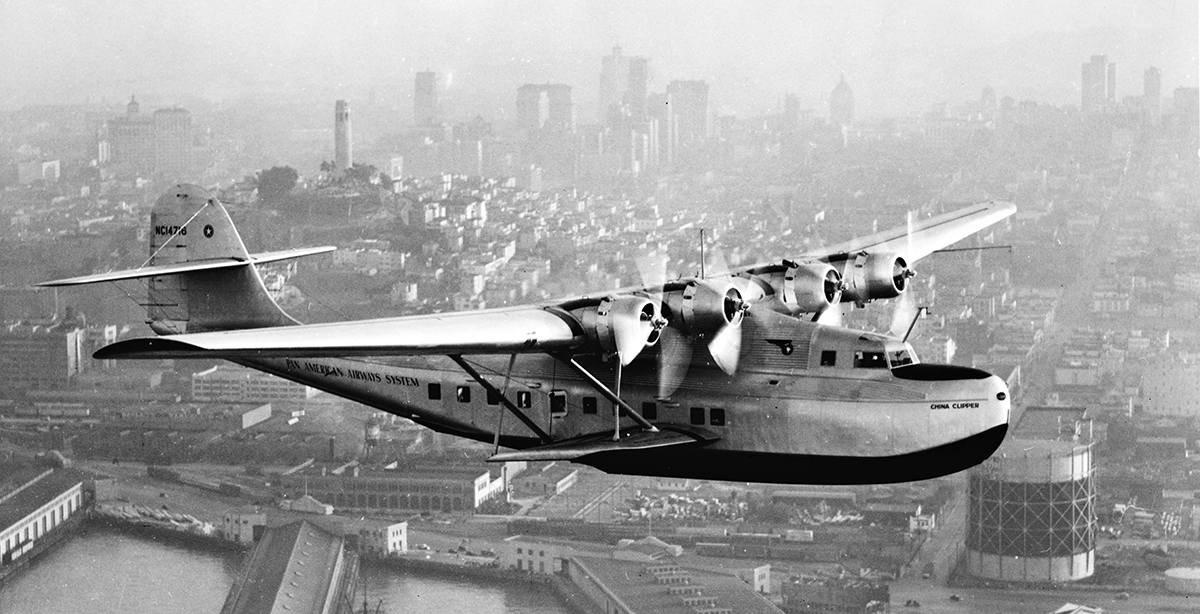
Thirty-two years before the first China Clipper flight, on December 17, 1903, the Wright Brothers flew 120 feet (about 36.5 meters). Thirty-four years after the flight, in 1959, the Boeing 707 was ferrying passengers from New York to San Francisco in 4 to 5.5 hours at 515 to 600 miles per hour (about 825-965 km/h) and at a cruising altitude of 25,000 to 40,000 feet (7,600 to 12,200 meters).
Today, we can scarcely imagine a time, just 150 years ago, when there were no paved roads across America, and a trip by train from New York to San Francisco took seven days.
The point to be taken from the amazing conquest of distance, so far, is that rapid innovation is an invention of the 20th century, and that it has created a very different world of work than existed before.
Hardly anyone today expects to spend an entire lifetime working for the same company. Nowadays, companies either change their products and services, evolving into something other than they were, or they perish.
The Energy Age has brought a world that looks increasingly unstable and insecure, where no institution or government can reverse the clock and bring back the old, comfortable stability of former times.
For many, the pace and nature of the changes have been frightening, and they have dug in their heels and stoutly resisted the accelerated pace of life and the apparent destruction of cherished institutions, seeing little good in a future where seemingly nothing will be stable, secure, and the same.
Yet not all of the developments of the Energy Age have been destructive. Many well-intentioned souls are using the new energy-based tools for good; and many traditions, believed to be threatened, have begun to reshape themselves in more fluid and energy-aware ways without compromising their integrity.
Still, the pace of innovation, even of good and useful things, is relentless, and it has brought a need for new skills in the workplace.
In the old world of matter-awareness, we all knew our place. We dressed the same, and we adopted the same polite linguistic formulas for interacting with each other in predictable situations.
Life moved more slowly. There was plenty of time for decorum. Today, there is not.
The qualities that people require to succeed at work today include personal skills that can enable them to work together efficiently and harmoniously while responding to the demand for rapid change. In successful companies today, hierarchies are becoming less important, subordinated to a need to work together creatively and cooperatively to get things done.
In the Living Wisdom Schools, the children are taught, starting with their first day in kindergarten, the words they can say to ask for what they want or need.
A five-year-old learns the exact words he can say to his friend when he wants to play with his friend’s toy. The kindergarteners learn to deal with troublesome feelings realistically. They learn how they can change their energy as a first step to overcoming moods and reconnecting in harmony with their friends.
In all of the classrooms, the children are never taught to “study to the test,” which yields superficial, quickly forgotten knowledge.
Instead, the teachers ensure that every child understands the underlying principles, whether in math, language arts, science, history, or the arts.

This applies also to the development of the children’s personal skills. The teachers scrupulously observe the students’ interactions, and when they see ill-conceived or negative behaviors or conflict, they never let those situations slide – “Oh well, kids will be kids – life will be their teacher.” Instead, they immediately step in and apply their EFL training to ensure that the kids learn lessons in conflict resolution and emotional self-management that will serve them for the rest of their lives.
What are the skills that will empower people to succeed in the workplace of the age of energy?
The answer, as Google discovered when it decided, fifteen years after its founding, to review the qualities of its best-performing employees and research teams, is that technical knowledge is no longer atop the list of skills that define the highest contributing employees in modern business and technology environments.
Google found that while technical know-how is indispensable, when it came to the defining traits of its most successful individual employees and research teams, it was in eighth place. (See the chapter “Happiness & Success at Google.”) The top seven qualities of Google’s best employees and teams were all “soft skills” that enabled them to work together harmoniously and efficiently while supporting each other.
In the new, adaptable workplace, the human need is not for rigid conformity but for communication, flexibility, negotiation, and mutual support. The most successful employees in the energy age will be those who can remain calm, focused, harmonious, cooperative, supportive, creative, energized, and adaptable.
In the past, the emphasis was on mass conformity to ensure the smooth functioning of big, inflexible institutions – to keep the big ship sailing steadily on its course.
Individualism was seen as a threat. Screwball ideas were not welcome. Managers in the Material Age feared anything that might risk destabilizing the system by throwing a spanner in the works of its smooth operation. Without rigid conformity, surely the workplace would devolve into a mass of squirming eels, all struggling to move in their own chaotic directions.
How can an organization pivot nimbly in today’s business environment, unless its team members have learned to be skillful problem-solvers – mobile, adaptable, curious, creative, calm, centered, and able to cooperate, with joy?
Daily work in the energy age is no longer only about production, it is about adaptation.
In the old economy, technical skills and university degrees were prized as evidence that a job applicant could work well within the system.
But a more pressing question in the energy-based economy is: “What personal skills will enable the business to respond with agility?” In the energy age, success will be theirs who can create energy and identify the most efficient ways to leverage it.
What kind of person will you want on your team? The one who is not threatened by the rapid pace of change, and who isn’t desperately trying to control the moment, but who greets each new challenge with curiosity and creativity, eager to solve the problems that will be bound to arise? Or the one who is focused on a faraway future when he/she will enjoy an illusory stability built on rickety props of wealth, title, and the envy and admiration of others.
In the age of energy, we will choose the applicant who is genuinely interested in the challenges of the moment, and who will want to share with us in the joy of finding creative solutions.

That kind of employee will rarely emerge fully formed from the womb. They may be shaped to a degree by their parents, but surely they will be influenced by the 180 days of the year and the six hours a day, times the twelve, sixteen, eighteen, or more years they will spend in school – twelve to sixteen thousand hours in all.
School is where they will be trained, if they are fortunate, to be top-tier employees in the energy economy. School is where they will become people who know how to cooperate, concentrate, contribute, innovate, and include, while remaining calm, present, centered, and emotionally expansive in an environment of discovery and invention.
These are skills that Education for Life gives young people – not for their long-delayed success and happiness in some far-off, imagined future, but for their daily successes and happiness today, which will inevitably bring their own bright future to fruition.
To discover how Education for Life gives children the skills to thrive in today’s workplace, read on.
If you would like to learn more about the 24,000-year cycles, we can heartily recommend a book, The Yugas, by Joseph Selbie and David Steinmetz.