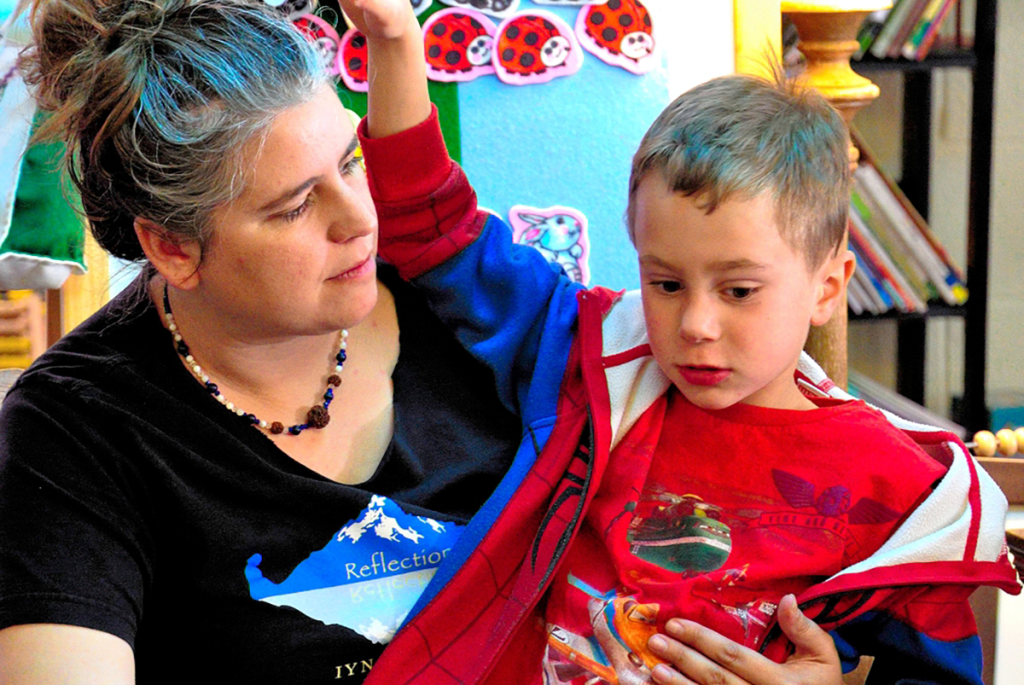
A conversation with Mahita Matulich, former kindergarten teacher at Living Wisdom School in Palo Alto.
Q: Mahita, how did you become a teacher at Living Wisdom School?
Mahita: I first heard of the school when I was living in my spiritual teacher’s ashram, and my roommate invited me to the school’s annual theater production. I was completely blown away — I could not believe the quality of the performances, and the children’s energy and poise!
I returned every year and watched the plays on Krishna, Hafiz, and the Dalai Lama, and I would always leave feeling deeply moved.
I had been studying early childhood education, and my roommate introduced me to Helen Purcell, the director, and Gary McSweeney who was teaching grades six through eight and was one of the school’s founders. At their invitation I came on staff as a teaching intern in the kindergarten.
Q: How has it been for you to teach kindergarten in an Education for Life school?
Mahita: I love teaching here. It’s been a great blessing, but I was surprised by how much energy it demanded. My greatest challenge was to adjust my energy to the needs of the children.
The energy that’s required of our teachers is tremendous, especially when you’re working with the youngest kids. I find that I must be very mindful of my actions, my words, and my encounters with each child. With children of four to six, even the smallest interaction can be very significant for them, especially when it’s coming from their teacher, so it requires that I be very aware.
Q: Have you always wanted to teach?
Mahita: I had never thought of teaching, although I had strong ideas about education that were based on my own early experiences, which were unique and unusual.
My mother is a professor, and my grandmother was a teacher, so there was always encouragement to be a lifelong learner. But I had no idea that teaching was what God had in store for me.
I had a wonderful kindergarten teacher. I still have vivid memories of her. My first three teachers touched my life profoundly, because they knew how to inspire our creativity and help us find the joy in learning. As a result, I grew up knowing what a tremendous difference it can make for children to have strong teachers in their earliest years.
Q: You mention creativity and learning. That’s a strong theme in the school, isn’t it – to tie those together?
Mahita: It’s huge! During an open house for prospective parents, a mother asked me, “How do you get the children to do things?” And I had to laugh, because it’s such a natural part of what we’re doing, and I’ve never had to think very hard about how I could motivate the children.
The way the children’s classroom experience is set up, they are given tremendous opportunities to exercise their creativity, and it engages them very deeply in what they’re doing.
For example, in math class, I might say, “What kind of math story do you want to write?” Or, “What kind of math story do you want to tell? Do you want to tell it with stuffed animals? Do you want to tell it using math cubes? Or do you want to tell your math story by drawing a picture?”
The emphasis on creativity inspires the children to want to participate. They aren’t as likely to resist learning, if they’re in a situation that welcomes their ideas and their creativity.
Q: Is it bringing their heart into the equation, instead of just the mind?
Mahita: Yes, it’s bringing the heart, the enthusiasm, and honoring each child by letting them know, “You’re important, and what you value, and your experiences, are important to me.” It’s telling the child that it matters a great deal to me as their teacher how they want to pour their creativity into a project, and how they want to approach their math.
Q: Do you interact with the other teachers? Do you feel that you’re part of a family of teachers together?
Mahita: I do. It’s a little different because I’m working with the very youngest children – there are mostly five-year-olds in my class, and a few four-years-olds and six-year-olds. But I’m very inspired by the other teachers. I look up to them, and I know that I can count on them if I need help.
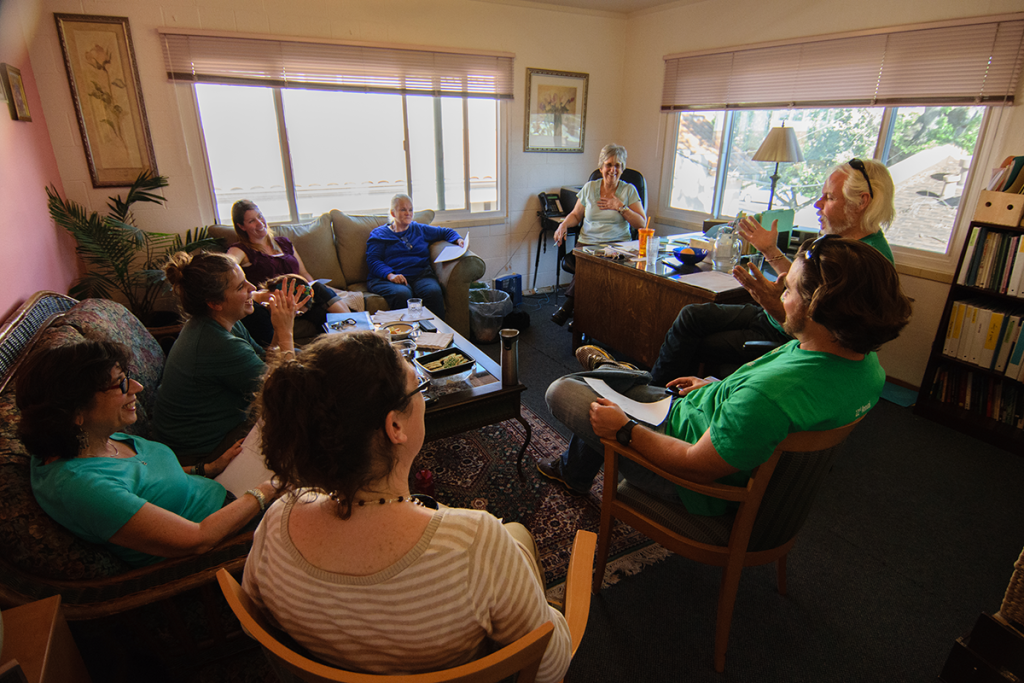
The feeling isn’t so much of a team, it’s more that I know that they’re very solid, and that we will always be there for each other. They are like old trees that I can go and sit under and get some cooling shade, or relief, or wisdom, and that we can talk about any kind of situation that might arise with a child. If I’m trying to figure out how to help a child have more energy, or if a child is feeling sad, I can ask the other teachers what they’ve done in similar situations. It’s a very solid support system.
Q: Did your own early education influence the kind of teacher you want to be?
Mahita: As I mentioned, I was lucky to have amazing teachers in kindergarten and first and second grade. After second grade, though, I got bored and lost interest in public school. I was a very smart child, and I wanted to learn more. I wanted to feel deeply engaged, and it wasn’t happening, so my dad took me out of public school when I was in fifth grade, and he home-schooled me.
We were living in Santa Cruz where there are beautiful redwood forests and beaches, and I spent two years with my father, learning about nature and reading and doing math outdoors. Those early experiences profoundly influenced the way I teach.
After being home-schooled, I skipped sixth grade, then I skipped eighth grade and most of high school and finished high school when I was fifteen. I went to a community college, and after getting my degree I spent some time traveling with my spiritual teacher. Then I became very interested in finding a career that would align with my goal of helping to create a more peaceful world.
The experience of being homeschooled by my father showed me how powerful it is when you are free to challenge children in ways that are deeply meaningful to them.
I feel it’s very important for the children in my classroom to be challenged, and that they not become bored or disinterested. If I sense that the children are sleepy, or that there’s some grumpiness in the room, I’ll change the curriculum and take them outdoors for a nature walk. Seeing the colors of the flowers, and being outside under the sun and sky transforms their day, and they come back with their energy renewed.
I try to incorporate nature into their daily experience, and I try to make sure they have time to be outdoors together among the trees and plants.
Q: You said that you challenge them. Can you talk about that?
Mahita: A very unique feature of our school is that we have an individualized curriculum, so that each child will be learning at his or her own level. It makes a lot of sense, because whether we are doing math, reading, or writing, every child will be learning somewhat differently.
I feel that my job is to challenge the children in many ways, and not just academically. Of course, I do challenge them academically, and if I see a child who is accomplishing their math tasks easily, I’ll make sure they have truly mastered those math skills, and I’ll immediately think of how I can keep challenging them at their level.
In our school, we recognize the importance of creating a relationship of trust with each child, so that the children will feel safe when we challenge them to go to the next level. If they think that they can’t do it, you are there to tell them, “I know you can.” And they will trust you enough to try, because they know you, and they know that you are never going to judge them.

I also challenge the children to be their best self. I hold very high standards for them – I expect them to treat each other kindly, and to articulate their words with care, and to practice having consideration for others. I challenge them to learn how to self-regulate – how to choose an appropriate activity to calm their bodies, like deep breathing. Or maybe they will need to sit and read a book for a while, until they can get calm and re-join the group.
Self-regulating can be very challenging for children four to six years old, but the Education for Life approach gives us priceless tools to help them manage their energy.
I’ve also been inspired by Bev Bos, a brilliant early childhood educator who believed in giving children a creative curriculum. My teaching has been very influenced by Bev, and by the Conscious Discipline methods we use here at Living Wisdom.
Conscious Discipline is a set of tools that help children learn the basic things they need to say and do. For example, I will never tell a child, “Say it nicely.” Instead, I will give them the exact words. “Say to your friend, ‘Can you please hand me the pencil?’” I’m modeling the sentences the children need to know to express themselves effectively. It’s a big part of what we’re doing at this age, teaching the children what they should say, and how they should say it.
I believe in Conscious Discipline very strongly, because it’s a beautiful approach, and it works. I think it’s wonderful that we’re encouraged here to help the children acquire these essential skills.
Q: Those seem like skills that might not be directly related to academics, but that will help them succeed – how to master challenges and how to find their way in small things and enjoy their successes.
Mahita: We’re teaching them to love the challenges, and to feel confident within themselves that even if something is challenging, they can do it. It’s about giving them a confidence from within, instead of trying to motivate them by external pressures and rewards.
I think it’s very important that the children learn how to be intrinsically motivated, so that they are motivated from within themselves to do their best, and not from outside. It’s why I don’t use sticker charts or reward systems. I’ve read lots of research on this, and I feel it’s best for the children if you can teach them, starting at a very early age, that the best rewards are when they’re able to look at their art, or their math, and feel very happy about it from inside.

Q: Is there an emphasis on language arts in kindergarten, and on helping them learn to read and write?
Mahita: Yes, because developing literacy and language is extremely important for young children. There are many studies on the importance of exposing children to words and environments that are rich in their variety, through printed materials and so on. They need to be exposed to a great many new words for their optimal growth, and it’s why I read lots and lots of stories to them.
Storytelling and story reading play a huge role in the curriculum at this age. I took a course on literacy and language development for young children, and I learned that you need to read slowly to children at this age, at a pace that’s significantly slower than you would read to an adult, because they’re forming a tremendous number of new ideas in their heads at this age, and they’re learning to understand the context of each new word.
So I’m very intentional in how I read to my class. I’ll make the voices of the characters in the stories, and in the second part of the year I’ll read lots of poetry to them, and I’ll get them started writing poetry, with prompts, because it’s very helpful for developing their language and thinking skills.
As far as writing goes, at this age I will wait to see when each one is truly ready to start doing his or her own writing. Some of the children will be ready to start writing words and sentences halfway through the year, and they’ll be very excited. Some will still want you to write out the words for them, which is fine, because they don’t all develop these skills at the same time.
I teach writing on whiteboards instead of paper, because it’s easier to erase and edit when you’re very young and still developing your fine motor skills. I teach phonics, so they can start to recognize the sounds of the letters, and work out the sounds of new words.
Language plays a huge role in how the classroom is structured. As I mentioned, I’m very careful about the language I use with the kids. I don’t tell them “Good job!” or “That’s perfect!” or “I really like that.” I stay away from those value judgments. Instead, I’ll try to find out about them, and how they’re feeling and where their energy is. “Tell me about your art. Tell me what you did. Oh, wow, I can see that you put green and blue there. Tell me about that.”
Q: They’re rewarded because you’re interested, and because they can tell you what’s fulfilling them?
Mahita: That’s right. When the children first enter kindergarten, they’ll hold up their art and say, “Do you like it? Did I do it right?” And it might take them a month or two, but then they’ll stop asking for approval, and they’ll start saying, “I did a masterpiece, Mahita!” Because they’re telling me how they feel about it, rather than asking if it’s right.
Q: Does it affect the way they approach their academic learning?
Mahita: Very definitely. They’re learning a process, and they’re learning to articulate, at a very young age, “This is what I feel, and this is what I need, and these are the tools I can use to calm myself and make myself feel better, and prepare myself to face this challenge.”
I don’t think that any human being can succeed academically, in the deepest and most lasting way, and to their full potential, if they aren’t able to self-regulate. As the children navigate high school and college, they will face many stressful situations, and having the tools to calm yourself and self-regulate and know what’s really alive within you will make a big difference.
I teach a high level of math in kindergarten. (Laughs) Some people don’t believe me when I say this, but I teach algebraic thinking at this age, and I really try to develop a solid number sense in the children. When they have a solid number sense, what happens is that they’ll breeze through math when they reach fourth and fifth grade, because they’ll have the right understanding from having worked on these things in a very hands-on, tangible way since they were four and five.
Q: You’re giving them content in kindergarten that they’ll be using in fourth and fifth grade?
Mahita: Exactly. For example, I might put on the board: “Ten is the same as five plus what number?” Or “Ten is the same as eight plus what number?”
Q: That’s amazing.
Mahita: They’re doing it all the time, so it becomes natural to them. I start teaching these concepts in the first or second week of school, and I do lots of things to make math fun. I have a Math Owl who tells math stories, and I do activities that bring out their natural joy, through storytelling, role playing, improv, and so on.
Q: The Education for Life book suggests that young children are working very much with their feelings, and that they need appropriate learning tools.
Mahita: Yes, and we’re using the most appropriate tools. We’re using the tools they naturally have. Children at this age play, and if we can incorporate play into what they’re learning, and make it playful for them, the learning sinks in more easily. We can then carefully observe what they’re learning, and what we can do to help them learn even better. I’m always watching them carefully and thinking of what I can bring to the classroom that will help them in their play.
Q: I visited the fourth-grade classroom, and the children’s focus was startling. It was inspiring to see them working in pairs and concentrated deeply on their math. There was no feeling at all that they wanted to be somewhere else.
Mahita: It’s astonishing. I think I may sometimes take it for granted, because I’m in the midst of it all the time. But I have five- and six-year-olds who are so dedicated to what they’re doing that they’re completely absorbed, and they’re engaged and excited.
Q: Five-year-olds are notoriously distractible. It’s fascinating to hear that they can be deeply focused, too.
Mahita: If you can frame an activity for children so that their enthusiasm is alive and they’re fully engaged, the learning happens naturally, and then you’re just there to support it.
I think it’s only when you aren’t framing a lesson or an exploration of ideas properly that the children are more easily distracted. I’m very, very carefully observing all the time what’s working and what isn’t, and what I need to fix. Maybe there’s a lot of joy around an activity, or maybe the energy is a bit too high and excitable. I have to be on my toes, and ready to adjust and stay flexible to adjust to each moment.
Q: It seems very different from the image of kids sitting in rows, all doing the same thing at the same time.
Mahita: I can’t imagine having kids sit at their desks all day, especially at this age. I can’t imagine how it would affect their learning and development.
I’m continually problem-solving and adjusting my teaching. I always have a curriculum planned for the next day, and the week and month, but if an activity isn’t working, or if it’s taking too long, or if the children are taking it to another level, I’ll go with that. There’s no doubt that being flexible is a key requirement for being an effective teacher.
Q: One of the most common complaints among public school teachers is that they are forced to follow a state-mandated curriculum, and it takes away their flexibility to adjust the curriculum to the needs of the individual student.
Mahita: At this age, they are naturally very curious. They naturally want to learn, and I feel it’s tragic when a child’s curiosity is shut down in an attempt to deliver some sort of prescribed lesson plan. My hope is that when the children leave here they will feel that they can ask questions and be curious and cultivate their natural love of learning, and not feel that there’s only one right answer, or that they have to stay quiet instead of asking questions.
I joke that if you come into a kindergarten and it’s too quiet, there’s no way learning is happening, because the kids aren’t naturally quiet while they’re learning. Sure, you want a reasonable level of quiet, but I feel that the best times of learning are when the children are excited and talking to each other about what’s going on, or they’re asking each other questions, or they’re asking me questions, so it’s very alive.
Q: Shawn Achor, the author of The Happiness Advantage, found that the most successful Harvard freshmen were not those who spent all their time trying to grind out good grades. The most successful students were engaged with each other, asking questions and forming study groups. They were social and knew how to get the help they needed. They were the kids who talked about everything, and knew how to enjoy what they were doing, and how to connect with it. And it sounds eerily similar to what you’re teaching these little scholars in kindergarten.
Mahita: It’s so important for these kids to learn the skills of cooperating and problem-solving. I wish you could see how they grow throughout the school year. At the start of the year there are always a few months where it’s just constant conflict resolution, and constantly learning to use the right words, and constantly giving them the sentences and words that will help them be successful.
Then, after a few months, they’ve gained enough skills that I’ll be able to sit and observe them for extended periods during the day, and they’ll be completely, one-hundred percent able to navigate and cooperate. And it’s not because I’ve solved their problems for them, but because I’ve challenged them, “How can you solve that problem?” And they start to become thinkers. “Oh, we both want to play this game, but we want to play it differently, and how can we do that?” Or they start to figure out the right way to ask their friends for help, and how to make requests of each other instead of grabbing.
It’s very rewarding as a teacher to see the transformation, and to consider, “Wow, most adults can’t even do this.” Can you put twelve adults in a room all day, and they’ll get along? Most likely not, and these kids can do it beautifully.
Q: Do you talk to the other teachers about how your students are getting along after they leave kindergarten?
Mahita: Definitely. I wrote an email to a parent today. I said, “As a teacher, you really love these children and care about them, and you can’t just switch it off.” It’s not like it switches off over the weekend, or when you go home. For me, it’s a big deal and very important to talk to the teachers that they will go to next year, because I want the next teacher to have all the information that enabled me to help each child during their kindergarten year. I’ll talk about their reading level, and what I’ve found that can help the child in a variety of situations, and I’ll let the first-grade teacher know that I’m always available if they have questions.
Teaching isn’t just about academics. It’s about having a sense of who each child is, and what’s important to them, so I’ll want to have conversations with their next teacher about that, too.
With an individualized curriculum, you basically have twelve curriculums going on at the same time, and as teachers our job is to make sure that each child is getting his or her individual needs met every day.