In an Education for Life school, the teachers invest tremendous energy to help the students learn how to get along. The goal is to create an environment that will be conducive to learning, where young children and teens can feel safe and secure to ask questions and experience the joys of supporting each other, instead of feeling constantly compelled to compete.
Some parents question this approach, feeling that every moment of the student’s time at school should be devoted to the academic curriculum. Yet this view may be misguided, as Matthew Lieberman, professor and Director of the Social Cognitive Neuroscience Lab at the UCLA Department of Psychology, Psychiatry and Biobehavioral Sciences explains in his book Social: Why Our Brains Are Wired to Connect.
It seems that children learn more efficiently when they are encouraged to connect socially in the classroom by tutoring each other and problem-solving together.
“Being socially connected is our brain’s lifelong passion,” Lieberman says. “It’s been baked into our operating system for tens of millions of years.”
“Someday, we will look back and wonder how we ever had lives, work, and schools that weren’t guided by the principles of the social brain.”
Lieberman believes schools could be dramatically improved by tapping the brain’s social potential. He notes that U.S. students’ interest in school tends to wane when they reach seventh and eighth grades — an age when, he says, humans become extremely social, and when most schools fail to nurture and wisely guide this instinct.
“Our school system says to turn off that social brain,” Lieberman said. “We typically don’t teach history by asking what Napoleon was thinking; we teach about territorial boundaries and make it as non-social as possible. Too often we take away what makes information learnable and memorable and emphasize chronology while leaving out the motivations.
“Eighth graders’ brains want to understand the social world and the minds of other people. We can tap into what middle school students are biologically predisposed to learn, and we can do this to improve instruction in history and English, and even math and science.”
In the Palo Alto Living Wisdom School, the annual all-school Theater Magic presentation engages every child directly and intimately with the life of a great historical figure — not merely the outward data of wars, treaties, and shifting borders, but their stature as human beings: their noble thoughts and high aspirations, their hard-fought personal battles, and their powerful message for our own lives and times.
Lieberman’s research suggests that students are more likely to remember information when they take it in socially. He believes schools could apply this principle by having older students tutor the younger ones, as routinely occurs in the classrooms of the Living Wisdom Schools.
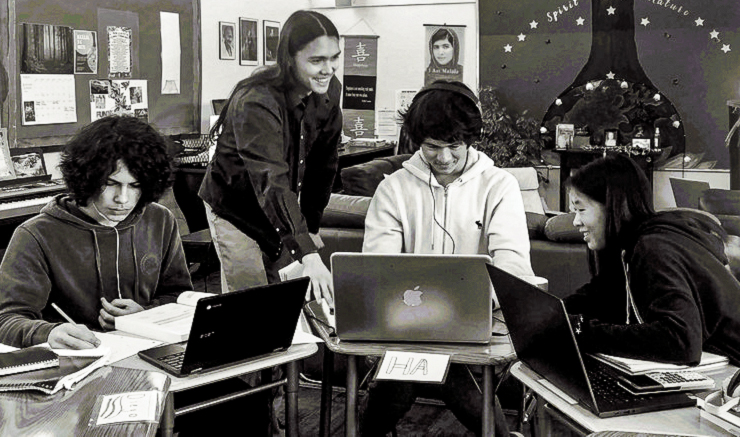
Photo: LWHS teacher Hazemach mentors a study group.)
“If you have an eighth grader teach a sixth grader, the eighth grader’s motivation is social: to help this other student and not embarrass himself,” Lieberman said. “Getting everyone to be both teacher and learner would create enthusiasm for learning.”
Social relates how Lieberman and his colleagues used functional magnetic resonance imaging (fMRI) to show that hardwired neural mechanisms make us profoundly social beings.
“We’re wired to see things and think, ‘How can I use this to help other people that I know?’” Lieberman said. “I can have the most brilliant idea for an invention, but if I can’t convey that to other people in a way that they’ll help me build it and market it to other people, it’s just an idea in my head. If we’re not socially connected, even great ideas wither.”
(Adapted from a UCLA news release about Prof. Lieberman’s work, authored by Stuart Wolpert and posted on October 10, 2013.