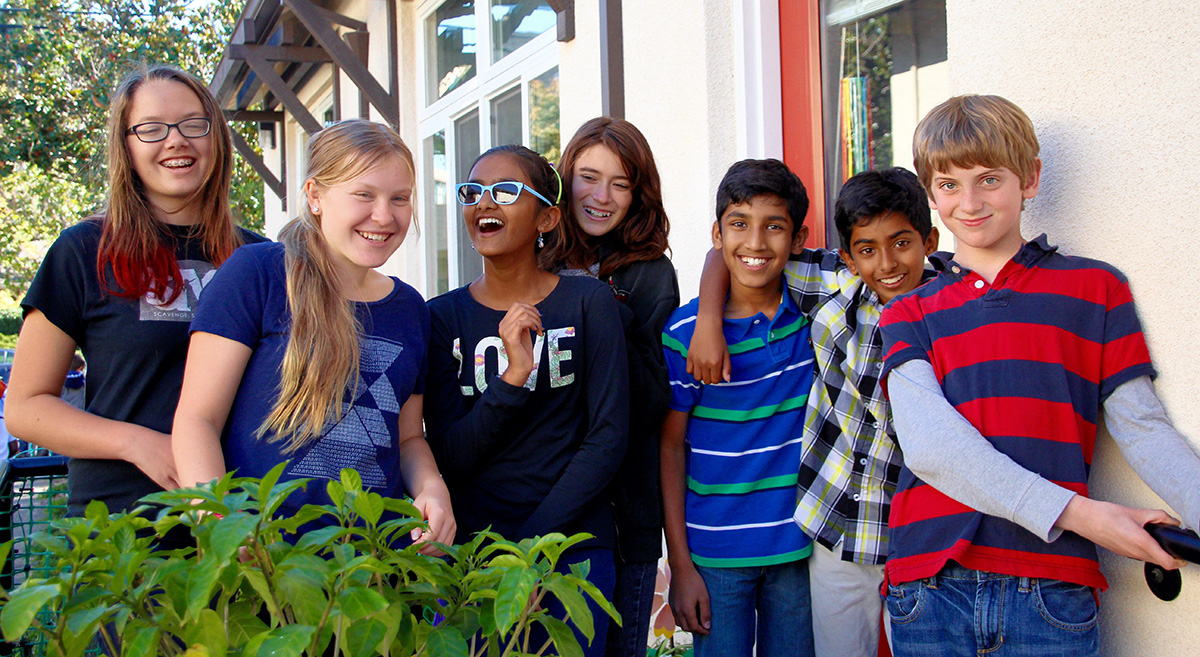
For more than fifty years, Education for Life has pioneered a radical approach to educating young people — an approach that empowers them to be happy, even as they excel in school and life.
In education today, there’s a quiet but powerful groundswell, a grassroots rebellion against older approaches that have hamstrung teachers, alienated students, and distorted the true purpose of education by placing the focus almost entirely on academics, while preventing children from receiving a well-rounded education that will prepare them to achieve success and fulfillment when they leave school.
The Education for Life philosophy can be stated simply: At school, the factor that most assuredly promotes deep, engaged, lasting learning is happiness.
Parents are often dumbfounded when they hear the Education for Life teachers proclaim that a happy, arts-enriched, highly individualized curriculum promotes more efficient learning than the “academically rigorous” curricula promised by other schools today.
They are nonplussed by the suggestion that the EFL curriculum gives children a deeper education, because the teachers continuously review principles with each student until they can master the concepts before moving on, instead of skimming the surface in an ill-considered rush to demonstrate good test scores.
Young people who are subjected to a one-sided, academically overloaded curriculum are at risk not only of receiving a relatively superficial education; they end up less well-prepared mentally and emotionally for success in college, career, and in their personal lives. Perhaps most troubling, they are less likely to acquire important personal qualities that are defining among the most successful employees in the modern workplace.
What are some qualities that we, as parents and teachers, should encourage in our children to prepare them for success in elementary school, high school, college, and career?
Aside from the technical knowledge and skills required to succeed in a profession, surely it is fair to suggest that there also needs to be a deep inner desire to do wonderful, personally meaningful and worthwhile things.
There needs to be a strong interior motivation, confident self-knowledge, a positive expectation, and an ability to work well with others — and these qualities must be deliberately cultivated in the early years. They cannot be imposed from without, nor will they magically appear as a side-effect of good grades and test scores.
These personal qualities, which are highly predictive of career success, cannot be nurtured by trying to motivate children to get good grades. Any motivation that grades and test scores provide will be superficial and will not touch their hearts. Worse, it may encourage a dependence on external recognition that can never be fully satisfied. After one test, there will always be another.
As will become evident in the pages that follow, success and happiness come most reliably to those who are focused enthusiastically on the process — who are not postponing their happiness until some vaguely imagined future time, but are able to rejoice in the expansion of their powers now.