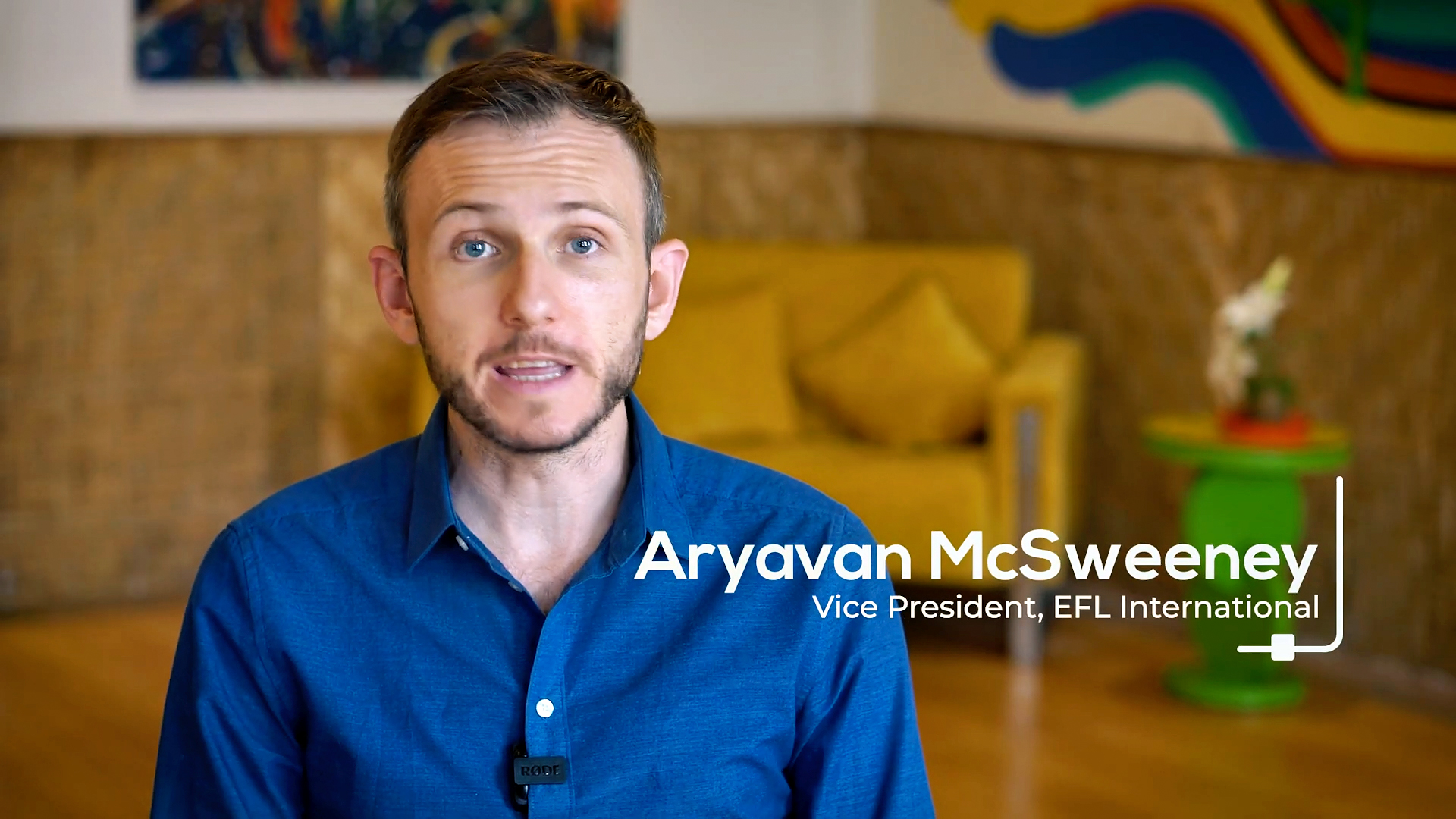
Aryavan McSweeney is no stranger to Education for Life. Aryavan entered kindergarten at Living Wisdom School in Palo Alto, California at age four and spent his first nine school years there.
Over the years, Aryavan’s school and work experiences would align organically to bring him back to his alma mater as its director and guiding light.
After graduating from St. Francis High School in Mountain View, California, Aryavan attended California State University at Fullerton, where he majored in film production. He and his wife, Ishani, also a filmmaker, created our school’s beautiful 6-minute introductory video.
After college, Aryavan spent several years in India producing documentary films. He then helped create successful Education for Life pilot programs at two public schools in New Delhi.
Back in the U.S., he taught at the original Living Wisdom School in Nevada City, California, before joining the Palo Alto Living Wisdom School as its director-in-training.
Q: How did you make the transition from video production to directing the school where you spent your early years?
Aryavan: When I was in India working in video, the founder of Education for Life, Swami Kriyananda, told me several times that I needed to be a teacher. He then repeated what he’d told me to a number of people whom I respected and couldn’t ignore, to make sure I got the message. (Laughs)
I knew I would be a teacher someday, but I couldn’t imagine how it would happen. So I was feeling a bit confused, when I got a call from the director of our high school in Nevada City, California. When he said, “We need a teacher!” I saw the writing on the wall and happily agreed.
A teacher’s first years can be notoriously challenging, but I had two things going for me. First, I would be teaching academic subjects that I was familiar with, and second, I had spent ten years as a young student in an EFL school. I had strong positive feelings about EFL, and I deeply believed in the philosophy and methods.
At first, I only taught physical education and nature education, then I co-taught with a senior teacher who was a wonderful mentor.
The following year, I taught on my own, and of course I made lots of mistakes. But I thought of them as valuable learning experiences, and there were plenty of successes along the way as well.
I taught seventh and eighth grades, and then I taught in our high school.
I loved the challenges – I loved the kids, and I loved that every day the challenges were completely new. Being a fledgling teacher stretched me in countless ways, but it also showed me that I could improvise, be flexible, and think on my feet, and that I could form connections with our wonderful young people.
Q: You’ve said elsewhere that the highest goal of education is to create a school environment where the prevailing energy is love. You added that teaching in that kind of atmosphere is an enormous advantage.
Aryavan: Yes. I do believe it’s true. It was actually the secret of our successes in India. But let me backtrack for a moment and tell you how we got started.
As Nitai explains in another chapter, (Can EFL Bring Happiness & Success to Traditional Schools, and Diverse Cultures?), we had been invited to introduce Education for Life in two schools that had operated for a long time in a very traditional way.
We felt that it would take a tremendous amount of patient explaining and demonstrating to help the teachers understand Education for Life and how it could help them.
We made our initial connection through a friend who was in charge of three pilot schools. The schools were part of a Corporate Social Responsibility initiative. CSR is an Indian government initiative that requires corporations above a certain size to contribute two percent of their profits to serve society. They can build hospitals, start schools, distribute food, and so on, and they can choose the particulars, but their participation is mandated by law.
The problem with the schools was that their approach was rigidly traditional, and the leaders were urgently seeking fresh insights.
The sponsoring company was running the schools as a secondary part of its CSR initiatives – their primary CSR focus was giving scholarships to students from low-income backgrounds and placing them in regular schools. So they were thinking that they might not actually need to be running their own schools, and the idea was that they should either sell them, or make them special in some way.
Pia Singh, who was in charge of the company’s CSR efforts, told a colleague, “Go find me something different in education. Find me something special that we can introduce in our schools to change them radically.”
The CSR director was part of Ananda Sangha, the founding organization behind EFL. But EFL was completely unknown in India, even though it had been highly successful for more than 50 years in America and Europe.
Meanwhile, in the course of her research, the colleague found EFL, and when she told her boss about it, she remarked, “By the way, isn’t this part of your guru’s work?” So that’s how we were able to make a connection for the pilot programs.
Q: How did you introduce the ideas? Did you come into the schools and talk to the teachers?
Aryavan: I was working with an EFL teacher who had spent many years teaching in India, so I had a bit of a head start. Then Nitai Deranja, who had co-founded EFL in America fifty-four years ago, came to India, and the three of us developed a pilot program.
We knew that we would be introducing EFL to teachers who knew absolutely nothing about it, and who were very busy teaching the established curriculum – and now EFL was being foisted on them in addition to their regular work. So we were braced for resistance, and we knew that we would have to make it as attractive and relevant for them as possible, and we would need to do so very quickly.
In our discussions, we realized that while there are lots of ways to explain EFL, and that we can boil them all down to the simple idea that we should give the teachers permission to express love. (Laughs)
It sounds strange to speak of giving teachers a chance to love their students, but it’s an essential part of EFL, and if it seems unusual, it’s because the existing system isn’t set up that way.
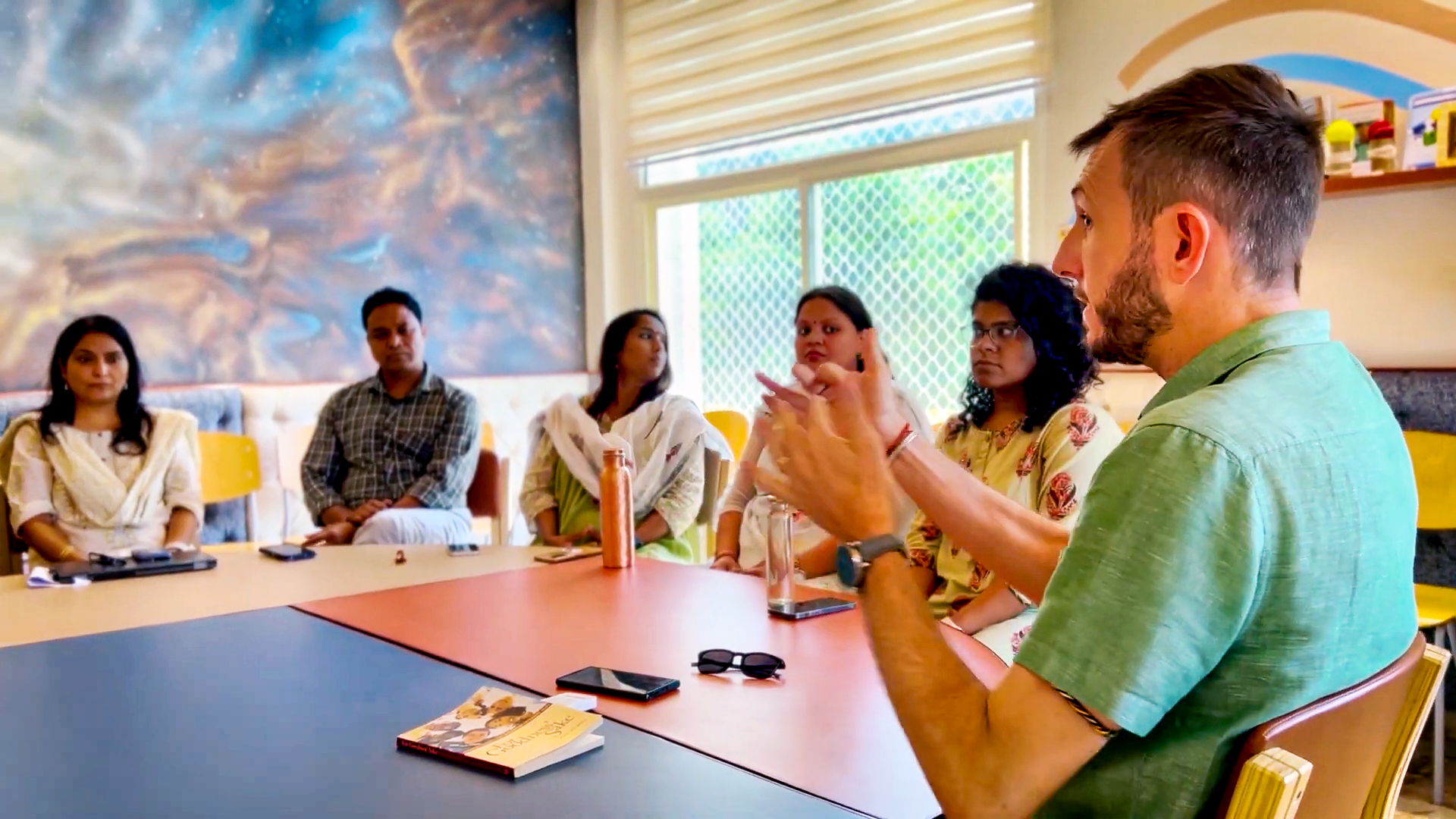
(Readers are cordially invited to enjoy a wonderful 4-minute video visit to the schools: Unlocking Children’s Inner Potential With Education for Life.)
We said, “If we can tell you about one part of EFL that will help you as teachers, it’s that it will help you make strong connections with the individual children you’re teaching.”
To make it practical, we led hands-on laboratories where we helped the teachers and children learn about each other by talking about human qualities such as compassion, kindness, and courage, none of which are normally discussed in schools.
We led practice rounds with the teachers, where we would pretend that they were the students, and we would talk about these human qualities, and about life skills and empathy, and making friends, and so on.
Then we said, “Oh, and by the way, now you are going to try it with your kids, and it will be your introduction to Education for Life.”
So we helped them have their own experiences of EFL. We taught the teachers to meditate, just as we teach the children in our schools. We played games with them that they could play with their kids, to help them develop life skills, like learning the right words to use when they want to ask for something.
We then talked with the teachers about life’s big questions, just as we do with our students. “Who are we?” “What are we doing here?” “What is the point of life?” We encouraged them to discuss these questions with their students in language appropriate to their age, as a way to get to know them individually.
Q: How did the teachers react?
Aryavan: At first they were understandably quite nervous. They had many concerns. “How am I going to find time for this?” “What’s the curriculum?” “Give me the curriculum guide.”
It was scary, especially because we had to tell them, “There is no fixed curriculum for this aspect of education.” Because you simply make time to meet with your students and have fun, and in the process you get to know them. And then you can truly figure out what each of them, individually, needs from you as their teacher.
You can ask your students very directly, “What do you want to learn about? What is important to you?” And in this way a teacher can gain insights about the children.
The important thing is that if you adjust the curriculum based on a deeper understanding of the individual child, the students begin to feel that you truly know them, that you care about them, and that you are on their side. It’s tremendously motivating for the students, because it means that once you understand their individual needs and strengths, you can give them success experiences every single day at school, at their level.
So all of this “touchy-feely stuff” actually ends up making the learning in academics much more efficient, because the children find their daily successes satisfying and enjoyable, and they want to more.
It also goes a long way toward eliminating that discipline problems that are more likely to occur under a rigid, one-size-fits-all approach, where perhaps a third of the students are learning at a level that matches their preparedness, while another third are falling behind or struggling to keep up and feeling judged as “stupid” or “retarded” or “failures,” and another third are bored out of their minds. So you end up with lots of pain, detachment, disappointment, and loss of motivation and inspiration in the classroom, and it can end up being disruptive
Also, we were able to reassure them that they wouldn’t have to take time away from their regular classroom instruction, because the schedule would remain the same, but we would take time during the weekly assembly to develop these skills, and we promised them that it would be a very worthwhile exchange.
There is no curriculum for this aspect of EFL, because the goal is to create an individual connection with each child, and it isn’t something you can be overly regimented and scheduled about.
We arranged for them to take forty-five minutes twice a week to explore their individual connections with the children, and at first they were quite nervous. But as they got into it, they found it very enjoyable, and most of them quickly began to make it their own.
For the first few weeks, they mostly did the things we had practiced together, but then they were pestering us to tell them what they could do next.
I had to say, “I don’t know. What do you think your students will want to do? Maybe you can invent something, or ask them to lead a class.”
This side of EFL is deliberately messy. It’s unpredictable and individual, because it revolves around the uniqueness of each child.
On the other hand, the academics in EFL are extremely well-organized, disciplined, and purposeful – all the more so, once you’ve formed those loving connections and the students begin to be motivated and engaged. But the process of making connections is completely individual, and you have to respond creatively to what each child might need from you.
All sorts of interesting things began to happen. The teachers would lead a class, and then they would ask the teenagers to lead classes, and they had third-graders leading the meditations.
They were doing things that Nitai and I had never thought of, that were truly creative and insightful, and that worked very well, because the ideas were based on the students’ unique needs. The methods at any given point reflected the teachers’ personal creativity and their own unique attunement to the children.
During our programs with the teachers, they weren’t generally working with children in the age group that they were used to teaching, so they were unable to teach from old habits. It was very effective, because it took them out of their comfort zone and showed them that they were much more capable and creative than they imagined, and that they could have a highly efficient classroom, because they were free to adapt the instruction to give each child those daily success experiences. So there was lots of progress for each one, and no one was failing or falling behind.
I would say that eighty percent of the teachers were able to do great things right away, and I imagine that by now they’ve all enjoyed those “Aha!” moments of creative expansion.
Q: If you have the heart of a teacher, it seems it would be liberating to be allowed to work directly and lovingly with your students, and to humanize the classroom in creative ways.
Aryavan: It’s very liberating! It’s teaching with respect for the deeper nature of the child and the teacher. It’s about our soul nature, and it’s something we all want to weave into whatever we’re doing. The teachers may be cautious at first, and fearful that the students might not perform as well on standardized tests. But when they experience the power of connecting with the individual child, they all want it, especially when they see the test scores improving.
They all went into teaching for a reason. Some people become teachers because it’s a career and they can go home at the same time as their kids, and so on. Others fall into teaching because they don’t have other prospects, and it’s the best job they can find. But fundamentally, human beings want to give and share and connect, because it gives us joy.
Children may be stuck in their old habits at first, but if you can give them a few small experiences of success, they quickly realize, “I like this!” When you teach them individually at their level, it’s very satisfying, and there’s a feeling, “Oh, this is nice. I want to do this again.”
So it connects the child to the curriculum in a way that rigid outward instruction can never do. We’ve found that this is true for children everywhere.
The particular form of personal expansion will be unique for each child and each teacher, but the experience of expansion is universal and profoundly satisfying.
Q: There’s no one who doesn’t enjoy the experience – “Oh, I can do this!” Or, “Oh, I can do this better than I thought!”
Aryavan: When we introduced the teachers to EFL, we had to think of them as children, very individually, in the way we would approach them in an EFL classroom, and we had to give them an experience of a more expansive way of teaching.
EFL is based on an understanding that you cannot effectively impose learning by preaching, scolding, or driving the students to perform.
The answer is to ask, “How can we put the children in a situation that will give them an enjoyable experience of expanding their knowledge and skills at their level?” We can then let the process unfold naturally as the teacher connects with the children and continues to give them those happy experiences.
It’s why parents who visit our Palo Alto school are very surprised to see children from age four to eighteen enthusiastically engaged with their studies, and not wanting to be distracted lest they lose the enjoyable experience of absorption and expansion.
Once the teachers understand the method, our role is to support them. We are helping them learn from their own experiences. So we are always asking, “How did it go?” And they are sharing and comparing their experiences with us and with the other teachers, with enthusiasm and joy.
In an EFL school, the teachers are continually sharing new ideas with each other. “Oh, that’s a wonderful way to introduce fractions to a student who’s terrified of math – I can see how I can use it with my kids.”
The children become happier at school, and the teachers are happy to discover that they can help the students have an enjoyable experience of learning.
The school environment then changes dramatically – it becomes a dynamic, loving space, based on the simple connections between the students and teachers. It explains why our teaching staff has been quite stable, because of the feeling of lightness, success, and joy in an EFL school.
Many months after the trainings, I met eight teachers who had come from India for an EFL conference in Italy. They expressed how inspired they were to meet the other teachers, and by all that they had learned.
Because of the magnetism that EFL creates between the teachers, students, and parents, I suspect it will spread more widely than we can imagine. I believe it could play a major role in changing the direction of education, not only in India but everywhere, because of the infectious magnetism it releases.
I believe that India will be at the forefront, because they’ve been focused on rigid academics and board exams, and the students, parents, and teachers are feeling a need for something that will make getting an education more enjoyable and efficient, without losing excellence.
India moves quickly. When they find something that works, they go for it. It’s something they do very well, that they are able to pivot quickly when they see a better option. The startup culture in India is stunning, with untold numbers of entrepreneurs bringing amazing new ideas and ways of doing things.
It’s a wonderful consciousness. The challenge is that the successes are too often ascribed to the older education system. The Indian school system isn’t preventing India from progressing, but there is a creative energy in the culture that could take the country much farther, if the education system could revolutionize itself, as I expect it will.
The national education policy document that the government published in 2020 reads like something straight out of EFL. It’s deeply focused on developing our human qualities, and on going back to educating the individual, and to the study of great people, and studying India’s great culture.
Because India can pivot rapidly, it may happen there long before it could shift the mainstream schools in the U.S., and then we may eventually pick it up from them.
Q: It’s been suggested that it takes only a small group of people working with focused energy together to change an entire culture. Many of the private schools in the Palo Alto area have changed their marketing to say that they’re doing what EFL does, even if they’re actually only doing a fraction. But it shows that EFL has had an impact, and that it is addressing a felt need.
Aryavan: The challenge is that it’s easy to talk about, but it’s more difficult to do, because it requires a deep change. Schools are wanting to do it, because it’s very attractive to the soul. At some level, they are doing it, or they’re wanting to, because it’s more fulfilling for the children, parents, teachers, and administrators.
But because it’s subtle, individualized, and unstructured, it’s difficult to see the broad scope of its effects. We’re able to see it here in America because we’ve been doing it for more than fifty years. Yet it’s difficult to get it accepted in the U.S., where the government is paralyzed by numbers and utterly blind to these human factors. It’s our hope that as people see the EFL graduates walking in the world, they will be inspired to change.
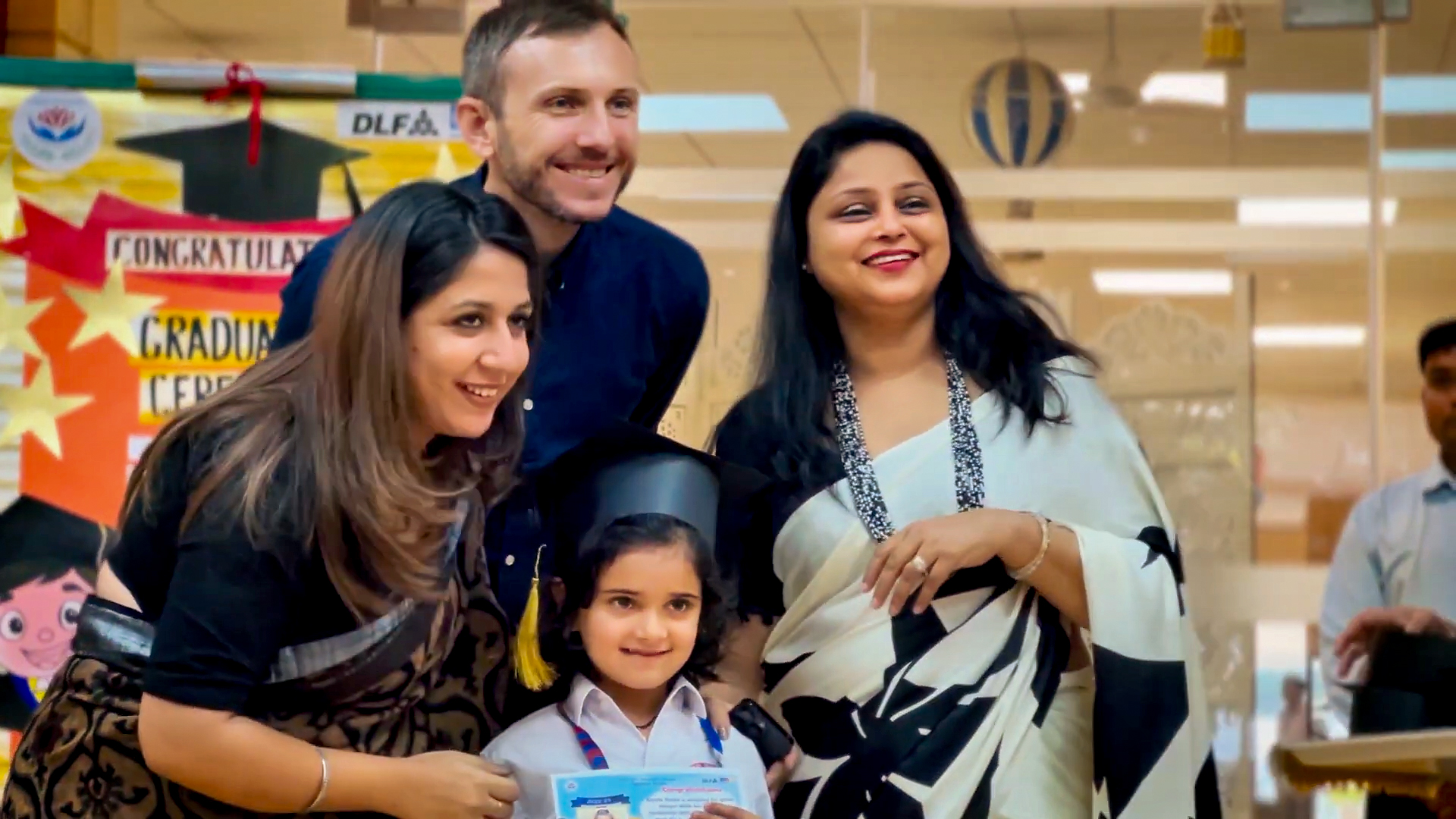
Q: You’ve shown that schools can incorporate EFL without changing the curriculum or the schedules. But if you want to create full-fledged Education for Life schools, you need lots of teachers, because it’s individually focused and requires smaller class sizes. Do you think that it will be less of a problem in India, perhaps with the help of the Corporate Social Responsibility programs.
Aryavan: Granting that the teachers we introduced to EFL in India have not trained at the level of the teachers in our EFL schools in America and Europe, where we have full control and can train our own teachers, nevertheless in India we were able to train a hundred teachers from two schools, and that was as many EFL teachers as there were outside of India at the time.
It’s not as if they will all become full-time EFL teachers. But if you consider that we were able to reach a hundred teachers with a small pilot program, it suggests that we’re headed toward reaching thousands. And if those thousands can understand even twenty percent of EFL, they might change the temperature by twenty percent of it, it will have an enormous impact and reach thousands more.
Q: This is a bit off the topic, but Swami Kriyananda, the co-founder of EFL, strongly believed that fresh ideas tend to spread through the popular arts, because artists tend to be among the first to pick up on new currents of thought and inspiration.
In that context, it seems that Indian films like Three Idiots show the artistic consciousness reaching into places where society hasn’t yet gone, but where its soul wants to go. Because Three Idiots emphatically shows what’s wrong with an overly rigid system that ignores human and individual values in education, and it does so very humorously.
Aryavan: I agree. There’s also a recent film, 12 Fails, that deals with similar themes, and that was a big hit in India. It was about the focus on exams and boards, and how it’s strangling creativity and joy. It hit hard and was very popular.
So the need for change is in the air. But at this point people are wondering with urgency: “Now what?” “Now how?” Because if you simply stir the education pot, it doesn’t help, nor will untested theories, or going backward. So you have to fix what’s there, and it seems awkward, when there’s so much energy invested in one direction. We’ve shown that it can be done easily, without changing the academic side, and with a minimal investment of money and time. Still, education is a huge industry with a great deal of inertia, and it’s a gigantic political and industrial complex. So the changes will doubtless have to come by demonstrating EFL in a spreading network of many small pilot programs.
Q: If there is one thing that the EFL schools have shown, it’s that happy children do well academically because they love school. Our kindergarten teacher, Suryani, tells how her kids will weep bitterly when they can’t come to school because of illness.
In India, there’s a strong philosophical current in the culture that supports the idea that if we can get our human instruments of action and perception – our body, heart, will, mind, and soul – energized and harmonized, the outward results will follow, in terms of school grades and life success.
Aryavan: It’s essentially what the Indian National Education Policy is saying: that we need to share the wisdom of our culture through our schools. I’m paraphrasing, but that’s the intent, that true education is about acquiring the wisdom, knowledge, and personal qualities that alone can make life fulfilling and worthwhile.
Of course, it’s couched in technical, intellectual, and political terms, but they know. And now the question is how to turn around the battleship around. We’re hoping to help Indian educators make tiny adjustments, and at first you won’t notice much change, but then slowly, slowly, you begin to notice, and eventually it’s turned around.
Q: You can set up laboratories where you can try the new medicine, and in time you can get it more broadly approved.
Aryavan: The path that we followed in India was to seize the opportunities that opened naturally to us. We’ve now introduced EFL to teachers in a wealthier school and a mid-range school. The next step will be to try it in a government-aided school that is the equivalent of a public school in the U.S. It isn’t an actual equivalent, of course, but it’s similar to a public school for the children of poor families. It may take lots of local adjustment and patience, but when it works, as I know it will, we will have a very strong argument: “Look – this can work anywhere!”
It has worked in a broad spectrum of schools, and although I’m only guessing, I can imagine us eventually starting a well-funded school in India from scratch with EFL at its core, as a training center and model school where the core principles will be kept pure and strong.
With these elements in place, we will have the data to show that our children are doing well on the board exams, even though we spend a liberal amount of time on finding out who they are, and relating the curriculum to their reality, and all of the other things that go along with EFL, such as using the arts as a medium for personal development, and using theater to study the lives of great individuals in a powerfully engaging, inspiring, fun and totally memorable way, and to deepen their understanding of the curriculum, and of life’s meaning and high purpose.
We already have abundant data from our U.S. schools to show that our children do well on standardized testing, and that they live happy, successful lives, and that they don’t have to sacrifice financially to be happy, but that they do have to prioritize what’s going on inside.
Q: The idea of an education that is both humanized and highly efficient is powerful. When the present generation of adults in the U.S. were in school, there was a rigid curriculum where every child was expected to cover X pages and take the same test. But what happened is that it was like a wire with too much resistance, and the learning moved forward slowly. Whereas if you take the resistance out because you’ve got enthusiastic little kids who are squared away and happy and have all of their human faculties nurtured and engaged, you find that learning becomes much more efficient, and as a major fringe benefit, it’s much more enjoyable. As you said, most of the discipline problems go away, because the children are enjoying school and no longer want to waste time acting up.
Often, it’s the parents, and particularly the grandparents, who become indignant. “You’re wasting all this time getting to know the kid! School should not be happy! It should be hard! It should be painful!” But what you’re doing in EFL is making a very fast, efficient wire, a superconductor kind of wire that enables learning to happen quickly because the kids are happy.
Aryavan: Yes. It takes more time to build a Lamborghini than a Ford Focus, but do you not build the Lamborghini? (Laughs) No, because it’s a faster machine. It will take longer to build, but once you assemble it, it will outpace everything else. It will overtake the Focus, for sure. I can understand why it’s hard for some adults to understand, because it looks slow.
Q: It looks like you’re putting obstacles in the child’s path to success, defined as acceptance to a top university, a prestigious job, and financial security. But then it’s almost mystical how you suddenly find that the children are learning at a faster rate.
There’s a saying of the elite U.S. Navy SEALs: “Slow is smooth, smooth is fast.” When you take time to very deliberately get a solid foundation, you find things working smoothly, and because they are working smoothly, the learning comes along much faster.
Aryavan: I believe that parents deserve the opportunity to be comforted and helped to feel good about how their children are being nurtured at school. Because that’s where a lot of the resistance comes from, in India and everywhere, through pressure from the parents.
Here in our Palo Alto school, we receive large numbers of applications from parents who were educated in cultures that value a very intensive education. Yet what I hear the parents saying, over and over, is, “I don’t want them to have the same education I had. I got through it, and I’m grateful, because I was successful because of it. But I realize that I could have been equally successful if I had enjoyed school, where the material was presented a little differently, and I would have been just as prepared and well-educated, but I could have had a happier time in school.”
They suffered through a system that served them functionally but not as human beings, and they suffered enough to realize “I want something different for my kids.”
We sometimes take the wrong lessons from suffering: “Everyone needs to suffer as I did, because it made me strong!” But our experience with EFL has shown that learning need not be forced and painful, because lockstep instruction isn’t the most efficient way to generate and channel energy.
Q: When you left India, were there others who took on the Education for Life initiative there?
Aryavan: Nitai, the EFL co-founder, is still leading our efforts in India. He is actively engaged and has moved into training EFL trainers.
One option is that we will someday have a teacher training center in partnership with an Indian school that is receptive to these ideas, where other schools can send their teachers to learn this approach.
A wonderful thing about EFL is that it’s systematic and well-defined, but it’s also very adaptable and reproducible.
This has been gratifying for us. As we’ve worked with educators at the state and national levels in India, we’ve been happy to be able to offer them a flexible concept under the umbrella of Education for Life as the overarching philosophy.
To summarize, EFL has begun to change the consciousness in education, in a structured way that can be readily adapted to a broad spectrum of individual circumstances and needs.
There’s no shortage of values education in India. The Ramakrishna Mission has a system that has been very popular, called Enlightened Citizen. The person I primarily worked with in India was Dr. Ameeta Wattal. She had worked in the Indian education system for over forty years, and she introduced me to a friend who was a school principal who wanted to talk about EFL. When I asked the principal about her previous work with Enlightened Citizen, she told me that while her teachers liked the ideas, the application was too rigidly structured to address the needs of the individual students, since it prescribed what they must do at every minute of the school day. Dr. Wattal explained to her friend how EFL is structured to allow the teacher to get to know each child and adjust the curriculum to their needs.
Q: Here in California, the EFL classrooms are very structured. The schedule for the day is structured, and there are schedules for the week and the school year. In kindergarten, for example, an hour is scheduled on Wednesday for a “Kinder Café,” where the children can help the teacher as she bakes cakes and cookies. They learn basic materials science and measuring. But within the daily lesson plan, the teacher has a great deal of freedom to help each child.
Aryavan: The children thrive when there is order and they know what’s expected of them. You cannot have only unstructured time, because it would be deeply unsettling for the children, and they would feel very insecure and unhappy. They thrive when there is focus and order, and when they are doing meaningful things that give them a sense of fulfillment and accomplishment.
There are teachers who can create order and structure without needing to be told how to do it. But more generally, planning and structure make things happier and smoother for the students and teachers. It’s a critical part of the foundation that allows the more flowing, creative, individual kind of learning to happen.
Q: In her kindergarten classroom, Suryani is constantly shifting her attention to creative things she can do in response to the needs of the moment. For example, during math, she can sense when a child needs her help, because she knows them on a deep level, and she’s free to help them personally, instead of standing at the front of a room with desks in neat rows saying, “Children, now open your books to page five.” A small class size is important to allow both structured and unstructured teaching.
Aryavan: In Gurgaon the class sizes were close to thirty, but we were able to adapt by doing EFL things with all of the kids and their teachers twice weekly in a large group at the same time.
You need small class sizes to work individually with the students, which is crucial in EFL. But it doesn’t always have to be small, because it’s also tremendously helpful if you can work regularly with a smaller teacher-student ratio, as we’ve done in the pilot programs in India. Meeting just twice a week allows the teachers and students to make those individual connections, and it has a powerful effect on changing the atmosphere in the larger group.
It can be difficult to turn around an existing system. Even if I were the world’s best EFL teacher, I would find it difficult, if not impossible, to connect with thirty kids, or worse, a new group of thirty kids every hour for six hours a day. But if the students can have even one teacher in the school that they can take time to connect with closely, it can make a world of difference.
It would be lovely if it was simply a question of hiring more EFL-trained teachers and cutting the class sizes. But the economic realities are unyielding, and to mandate a maximum class size of twelve would require too radical a change.
Q: Is it helpful to be in a culture like India’s that understands that it’s a worthwhile investment to develop “soft skills” at a young age, because you’re going to have extraordinary people coming out of the system?
Aryavan: Yes. Education funding in India is at less than three percent of the GDP now, and the internal reviews are saying it needs to be closer to six percent. The teachers should be paid more, and you should be able to cut class sizes, because those two things alone would dramatically change education in India, and you could pivot and make real progress.
But if the reforms are only about imposing more work on the teachers, it isn’t going to accomplish very much, because it will create a sour taste, as it has in the U.S. And if you were to try it in India, you still wouldn’t be paying the teachers a livable wage. So what’s the incentive for them to want to become engaged with new methods?
Q: It’s where you get cartoons about politicians entering the classroom and knowing it all.
Aryavan: (Laughs) Like the disastrous “No Child Left Behind” in the U.S., where the government mandated that all of the children must study at the same pace, and the results were judged by test scores.
Q: Let’s talk about your transition back to the U.S.
Aryavan: The short answer is that my father, who is a founding board member of our Palo Alto school, asked me to come back. He taught middle school for twenty years, and now he serves as the school manager. So it’s his fault that I’m director and can tell him what to do. (Laughs) But we knew that our founding director, Helen Purcell, would be retiring at the end of the school year in 2024, and the subject of my stepping in as her replacement was in the air.
Asha Nayaswami, another board member, told me repeatedly, “You should be here.” She said, “Our greatest need with EFL right now is to make sure that the Palo Alto school remains dynamic, and that it keeps growing, so that it can be a beacon for the future of EFL.”
I didn’t disagree, though I wasn’t sure I was up to the task. If I hadn’t spent so much time “selling” EFL in India, I might not have been ready, but that experience helped me understand the needs of teachers in today’s schools, and without the time in India the transition would have been more difficult.
The India experience deepened my understanding of EFL and how to apply it in situations that require wildly creative solutions. It forced me to grapple with what EFL means in the world outside our own schools, and how it can help people in unique and unfamiliar contexts. It also showed me how grateful and receptive people are for these simple solutions.
I remember a saying of Paramhansa Yogananda’s chief woman disciple, Sister Gyanamata: “Your spirituality is tested in the cold light of day.” That was my experience in India. I had to jump in and demonstrate, in real and practical ways, how EFL could help the children and the teachers.
The first week after I landed in Palo Alto, we began rehearsals for our all-school theater production, and I suddenly found myself directing the play and having to meet seventy kids and figure out how to work with them individually in the best way, even as the rehearsals were becoming increasingly complex and challenging.
When we were done with the play, I transitioned into admissions and other school-director activities, and I spent time helping our retiring director, Helen Purcell. At first, when parents visited the school to see if it was a good fit for their child, Helen would talk with them while I listened. Then she began asking me to lead the discussion, and finally she had me greet the parents. Because of my long familiarity with EFL, I was able to transition naturally into the role, and I found that my experiences in India were extremely helpful, because I had spent so much there time talking with parents and teachers.
Q: Where do you see the Palo Alto school going?
Aryavan: I’m keen to help Education for Life become better known in the U.S. For fifty years we’ve demonstrated its power to improve the lives and performance of students and teachers, and I believe the time has come to be more vigorous in offering it to those who feel a need and will be receptive.
It will be wonderful if our teachers can share their experiences with other teachers and parents and homeschoolers globally, both online and through summer programs.
It will grow gradually. But our school is the EFL flagship, since it has the highest concentration of seasoned EFL teachers, and my hope is that it will become a center where teachers can come from all over and share their discoveries. “This is how I work with children who are challenged by learning to read.” “This is how I help kids who are highly advanced in math and science.”
I’m grateful that I studied video production, and that I had an intensive video experience in India, because I’m very comfortable creating short videos, mini courses, and live webinars.
I see my role as giving EFL teachers everywhere the opportunity to share in a growing worldwide community of EFL educators. With our strong video backgrounds, my wife, Ishani, and I can create a smooth workflow for sharing this inspiration with teachers, parents, and fellow educators around the world.
I’ve run online EFL courses for years, and it strikes me that I’ve never closed a session where there was less energy at the end – it was always an energizing experience that left us soaring with inspiration. The teachers’ stories of their experiences with these methods are beautiful, and it’s very energizing to share them with others.
The EFL teachers receive tremendous gratitude from the parents. Still, they are too often unaware of the extremely high level at which they are operating as educators, and how profoundly they are helping the children.
Through my time with the EFL Institute, I have seen how priceless it is to share EFL with a wider community. I’ve listened to countless stories of beautiful transformations that happened for the children, and I want to ensure that those stories will be recorded and spread.
Q: It’s been said that the best executives manage by walking around – “MBWA.” They spend lots of time walking around the shop floor, watching how things are done and talking with people about how they do their jobs, and asking what they might need to do their work more enjoyably and efficiently.
Aryavan: I hope to be that kind of director. I plan to make it a major part of my role to give families an inside look at our school through videos, because there is so much inspiration we can share. Beyond words and concepts, the proof of EFL is in the small miracles that happen for the children every day.
The more we can share EFL, the better off our children will be. Our founder’s book, Education for Life, makes a strong case against cynicism and atheism, two poisonous influences that have ruined the school experience for countless children. I deeply believe that Education for Life is the antidote, because we’ve now been able to demonstrate very consistently for a little over a half century that children thrive when they learn that life is meaningful, and that our natural birthright is joy.